Image Credit: Epia Neuro
Epia Neuro is a San Francisco brain-computer interface company that came out of stealth in early April 2026. It is focused on restoring function for people with neurological conditions, starting with post-stroke motor impairment and later expanding to areas such as cognitive decline and other neurologic disorders. The company describe it as building “intent-driven” neurotechnology that translates brain signals into action. Their leadership team includes Michel Maharbiz, PhD as CEO, Gil Mandelbaum, PhD as Chief Technology and Science Officer, and Michelle Patruno as COO.
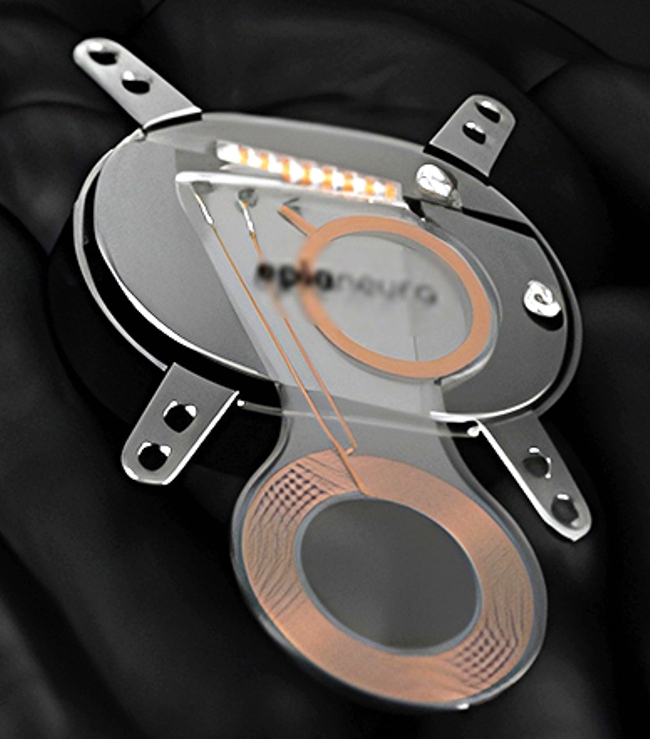
Epia’s first product is a dual-phase stroke therapy intended to support both rehabilitation after stroke and long-term assistive living. The platform combines:
- an implantable brain interface,
- a decoder/AI layer that interprets neural signals, and
- an external grip-assist motorized glove/prosthetic to help the user open and close the hand.
According to an article on WIRED, the basic idea is that after a stroke, a patient may still generate neural signals associated with the intent to move, even when those signals no longer produce useful hand movement. Epia says its system detects those signals and uses them to trigger or support gripping motion through the external device. WIRED summarizes the approach as an implant that detects signals “associated with a person’s intent to move their hand,” while AI algorithms combine those signals with data from sensors on the glove to “predict and drive gripping motion.”
The concept seems to be similar to Neuracle’s BCI (although for a different indication), which recently came into the news because it made China the first country to approve an invasive BCI device for commercial use. Neuracle’s BCI (made by Borui Kang Medical Technology) is indicated for quadriplegic patients aged 16 to 60 who cannot use their hands due to cervical spinal cord injuries. The implant reads the patient’s extradural EEG and activates an exoskeletal glove in response to the patient’s thoughts.