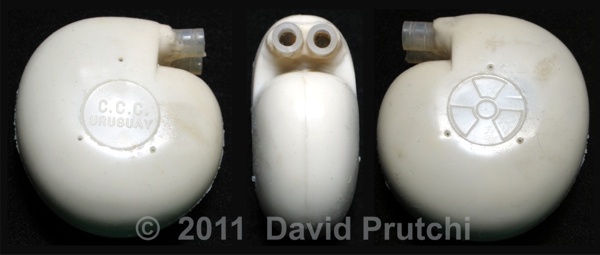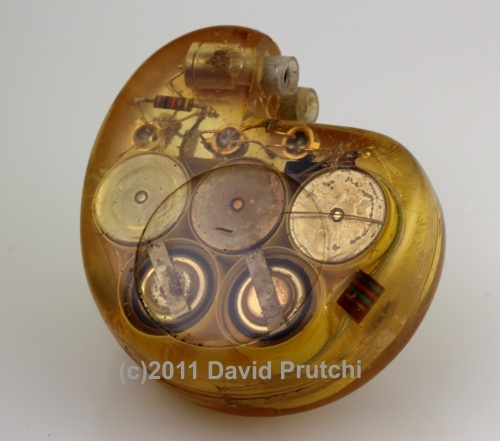
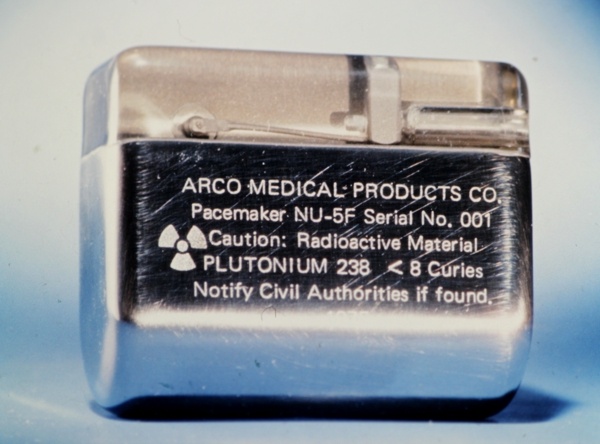
This was achieved in Uruguay on February 2, 1960 by Dr. Orestes Fiandra and Dr. Roberto Rubio. The pacemaker was manufactured by Dr. Rune Elmqvist of Elema-Schönander in Sweden, and was implanted in Uruguay in a 34-year-old patient with AV block. This unit worked successfully for nine and a half months, until the patient died of sepsis from an unrelated infection. Continue reading
Category Archives: Therapies
AIMDs classified according to general type of therapy
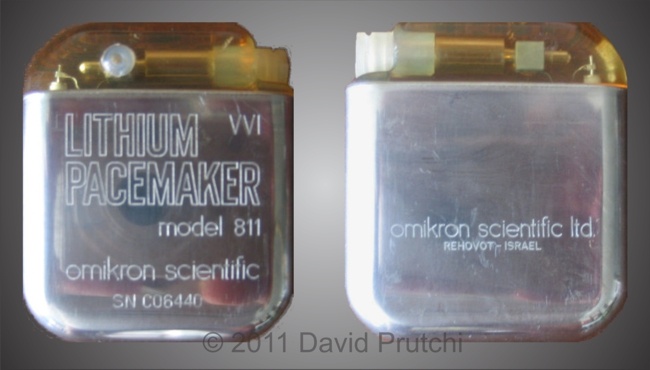
Omikron Scientific – Israeli Pacemaker Company (1979-1985)
Omikron Scientific was a small-scale pacemaker company founded in Rehovot, Israel in 1979. The company stopped pacemaker production in 1985.
Besides pacemakers, Omikron also produced a skin substitute called Omniderm, which was a thin, transparent, flexible membrane. It was used when a biological dressing would otherwise have been used.
Omikron’s pacemakers were all VVI and featured gradual decline Magnet Rate & Programmed Rate. Models included the 811 (6.5 year longevity), 811L (10 year longevity), 811XL (14 year longevity), 821 (VVIM with 8 year longevity), 837, a 838 (6.5 year longevity).
Click here for Omikron’s patents.
MicroTransponder’s Injectable Stimulators

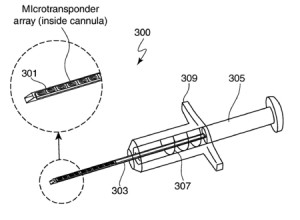
From US Patent Application Publication US 2009/0163889 A1
MicroTransponder was founded in Dallas, TX in 2007 when it licensed technology developed at University of Texas in Dallas (UTD) by Larry Cauller, who heads the cortical connections lab. The first wireless transponder was developed under a DARPA Revolutionizing Prosthetics grant to create a bi-directional neural interface for a prosthetic hand. Continue reading
Northstar Neuroscience’s Renova Cortical Stimulation System (1999-2009)

Northstar was founded in 1999 as Vertis Neuroscience headquartered in Seattle, WA, and the original goal was to develop electrical stimulation for chronic back pain. In 2003, under its new name, Northstar Neuroscience, then developed the Renova cortical stimulation system to deliver targeted electrical stimulation to the brain cortex as a treatment for stroke-related upper extremity. Continue reading
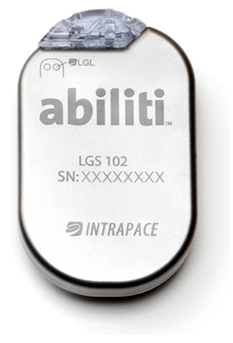
Intrapace Abiliti Gastric Stimulator for the Treatment of Obesity
Intrapace was founded in Mountain View, CA by Mir Imran in 2001 to develop an implantable system for the treatment of obesity. Once implanted and activated, the Abiliti system is designed to detect when a person consumes food or drink. When food or drink is detected, the system delivers a series of low-energy electrical impulses to the stomach intended to create a feeling of fullness.
In January 2011 Intrapace received the CE Mark for the Ability system.
The Ability IPG connects to the stomach via a lead that integrates the food sensor and stimulation electrodes. The sensor is able to detect food and drink and can trigger the abiliti stimulator device to create a feeling of fullness. These eating events, along with physical activity the patient engages in, are automatically recorded and available for downloading to a personal computer using the connect.abiliti Wand. Continue reading
Transneuronix Transcend IPG for Obesity Treatment
Transneuronix, Inc. was founded in 1995 and was based in Mount Arlington, New Jersey. It was acquired by Medtronic in 2005.
Before its acqusition by Medtronic, Transneuronix developed the Transcend, an implantable gastric stimulator device for the treatment of obesity by electrical stimulation of the stomach. Later, Medtronic developed the Transcend II IPG. Continue reading
EnteroMedics’ Maestro RC Vagus Nerve Stimulator for Obesity Management

EnteroMedics Inc. was founded in St. Paul, MN in 2002 to develop a platform for vagus-nerve stimulation, primarily for obesity management. In March 2011 EnteroMedics received the CE Mark for its second-generation system – the Maestro RC.
The EnteroMedics Maestro RC device delivers VBLOC® vagal blocking therapy to through laparoscopically implanted leads to intermittently block the vagus nerves using high-frequency, low-energy electrical impulses. VBLOC Therapy is intended to target the multiple digestive functions under control of the vagus nerves and to affect the perception of hunger and fullness. Continue reading
Transoma’s Sleuth Implantable Wireless ECG Monitor
Transoma was the name that Data Sciences International of St Paul, MN adopted in 2003 when it re-fucused its animal telemetry implant business to develop an implantable wireless system to capture electrocardiogram data for diagnosing human cardiac arrhythmias, as well as to monitor the electrical activity of the heart and transmit data from the patient’s home to monitoring centers.
In 2007, Transoma received FDA’s approval for its Sleuth implantable device to wirelessly monitor a patient’s ECG for possible diagnosis of arrhythmias and prevention of syncopal episodes. The Sleuth ECG Monitoring System included a High Definition Implantable Loop Recorder (HD-ILR), a Personal Diagnostic Manager, a Base Station and a Monitoring Center staffed 24/7. Continue reading
CerebralRx FitNeS Vagus Nerve Stimulator for Epilepsy Treatment

Image Credit: Biocontrol
In June 2011, Israeli neuromodulation systems developer BioControl Medical spun-off CerebralRx to market its FitNeS vagus nerve stimulation system for the treatment of refractory epilepsy.
The FitNes system employs platform technology developed for the CardioFit® system for treating congestive heart failure (HF). CerebralRx spun out of BioControl Medical to expand the use of this technology outside of cardiology for the treatment of a range of neurological disorders, including epilepsy.
Cyberonics’ Vagus Nerve Stimulators

Image credit: Cyberonics
Cyberonics was founded in Houston, TX in 1987 to develop an implantable device for the treatment of epilepsy. In July 1997, The FDA approved the VNS Therapy System (formerly known as the NCP® NeuroCybernetic Prosthesis System) as an adjunctive epilepsy treatment for adults and children over 12 years of age with partial onset seizures refractory to drugs.
Cyberonics currently markets the VNS Pulse and VNS Demipulse IPGs, which offer approximately 6 years of longevity at nominal stimulation settings (2 mA, 20 Hz, 500 msec, 10% duty cycle into a 4 kOhm load).
AIMD Companies Founded by Yossi Gross
Yossi Gross (born February 5, 1947) is an Israeli medical device innovator and entrepreneur. His medical-device companies are incubated through Rainbow Medical.
Currently, the following companies led by Yossi Gross are focusing on active implantable medical devices:
- BetaStim, developing a new neurostimulation treatment for diabetes
- Brainsgate, developing an implantable device for acute stroke treatment and brain drug-delivery technology
- BioControl Medical, developing neurostimulation devices
- Enopace Biomedical, developing implantable devices for heart failure treatment through stimulation of the aorta
- CerebralRx, a spin-off from Biocontrol developing vagus nerve stimulators for the treatment of epilepsy