This is a hack that combines three of my favorite passions: pacemakers, photography, and coffee!
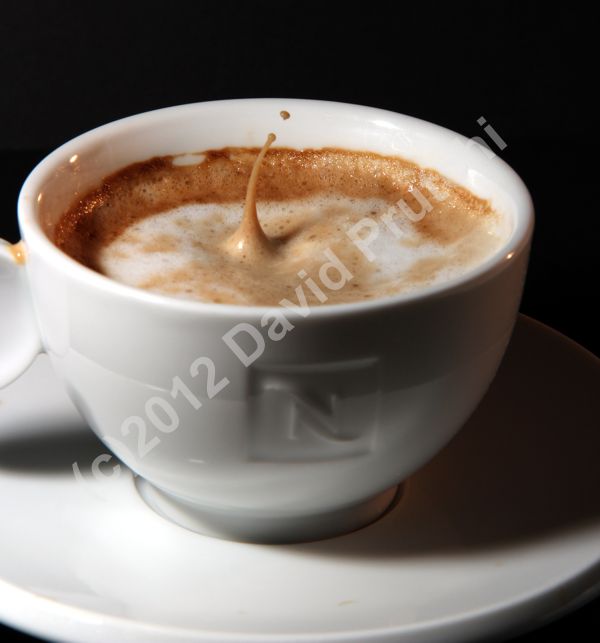
I took this photograph by feeding the output of an infrared barrier to the atrium input of an old DDD pacemaker, setting an appropriate AV delay, and using the ventricular output to trigger a camera flash (via a optoisolator). In a darkened room, I opened my camera’s shutter for 2 seconds. I then let one drop of milk fall through the infrared barrier, starting the AV delay in VAT mode. The flash then fires as the drop enters the coffee in the cup, freezing the action.
An action sequence is obtained by photographing drops with different delays. The delay can be adjusted by either changing the height of the IR barrier or reprogramming the AV delay.


[...] knew pacemakers were so versatile, I thought they only had one purpose. This Pacemaker Camera Flash Project sure proved me wrong. David Prutchi sent in his latest project where he has used an old pacemaker [...]
That’s an excellent way of thinking outside the box! Also, the pics are pretty nice.
/Jannich
David has set a new standard for pacemaker technology! Good going David!
Cool project. You shouild check out my clock driven by a pacer (ICD actualy) set at 60bpm. Search “pacer/defib clock” on youtube.
Clif
Very cool!
I found your video at: http://youtu.be/jvJ1xHStWmQ
Reminds me of the time when we were testing our “Patient Alert System” at Intermedics. The idea was to use a small electrode in the device’s header to cause pectoral muscle twitching when the IPG wanted to call the patient’s attention (e.g. low battery, dislodged lead, etc). To test it, we had modified a Relay pacemaker to be single chamber (VVI), and used the atrial channel for the “Patient Alert” electrode. For the test protocol, the device was programmed to issue a number of alert pulses to the patient at some hour set by the nurse but unknown to the patient, and the patient was supposed to call back whenever he/she felt the alert stimuli. We nicknamed it “Rolex” because it was just as expensive as the real thing, but not anywhere as accurate
Thanks for sharing.
Cheers,
David