
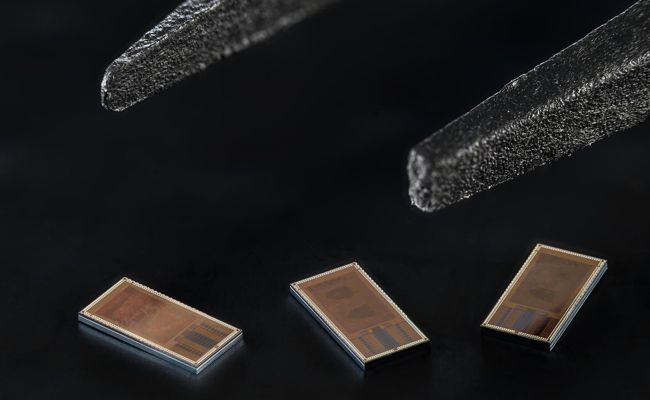
Image Credit: EPFL
EPFL (École Polytechnique Fédérale de Lausanne) researchers have developed LogSync, an approximately 4 × 2 mm neural system-on-chip intended for future adaptive neurostimulation systems. The chip extracts measures of oscillatory activity and synchronization between brain regions, then uses machine learning to classify cognitive or emotional states and generate stimulation triggers. According to EPFL’s October 23 announcement, the design consumes less than 200 µW, using logarithmic computation and joint hardware-algorithm development to reduce the processing demands of brain-network analysis. Evaluation combined previously collected human brain recordings with experiments in rats, where the system tracked oscillations and generated triggers at selected phases.