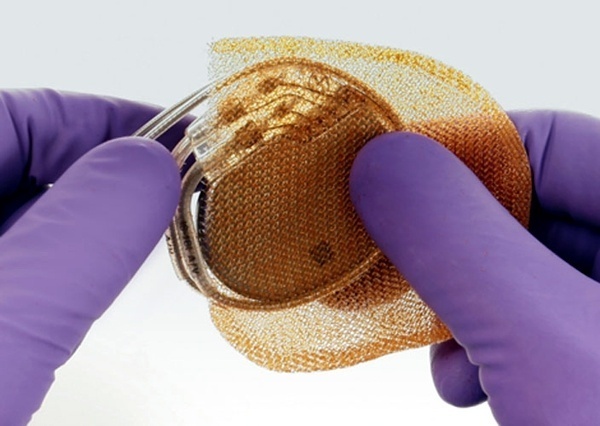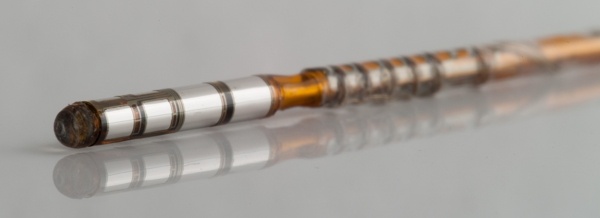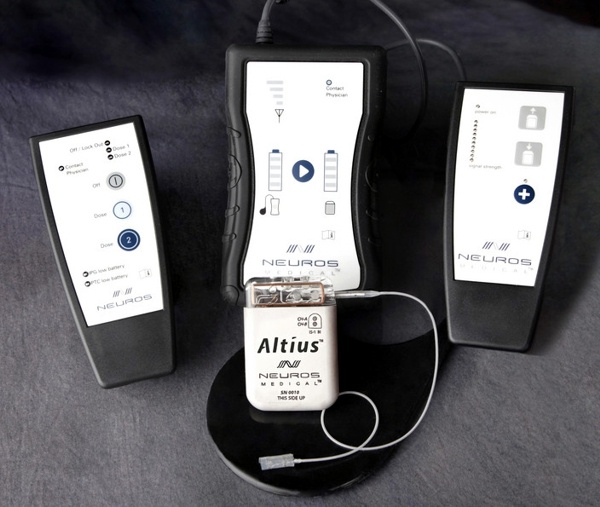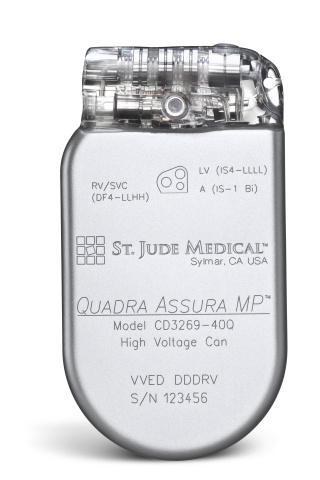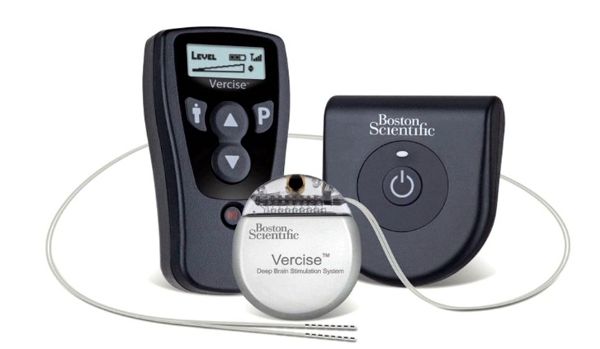
Boston Scientific announced today the first implantation of its Vercise™ DBS System as part of the INTREPID clinical trial. INTREPID is a prospective, multi-center, double-blinded, randomized, controlled study to evaluate the safety and effectiveness of motor function and overall quality of life in patients with the Vercise DBS System for the treatment of Parkinson’s disease. According to the press release:
Implantabe Preterm Labor Monitor
Not new, but recently came across while researching some information about related devices…
The NASA Tech Briefs of May 1999 described a device that telemeters pressure changes to detect intrauterine contractions. According to the brief:
A biotelemetric system for monitoring key physiological parameters of a fetus and its uterine environment is undergoing development. The main purpose of the monitoring is to detect preterm labor in order to enable timely treatment. At the present stage of development, the system monitors pressure changes and temperature. The pressure changes serve as direct indications of intrauterine contractions that could be associated with the onset of preterm labor. Future versions of the system are expected to monitor additional parameters, including pH and the heart rate of the fetus.
IEEE Summer School on Implantable Devices – Bogotá, Colombia (July 9 – 12, 2013)
I have been honored with an invitation to present at the Fourth IEEE CASS Summer School on Wearable and Implantable Biomedical Circuits and Systems in Bogotá, Colombia (July 9 – 12, 2013).
I will be giving two 1 hour and 20 minute talks on “A Practical Perspective on Developing Novel Commercial Active Implantable Medical Devices”. Unlike other commercial devices, developing medical implantable devices takes place in a heavily regulated environment which requires decisive proof of the devices’ safety and efficacy. Costs, schedules, and clinical strategies must be planned accordingly to achieve a successful exit. This two-part lecture will focus on the practical technical and business-oriented aspects of planning and executing the development of implantable medical devices intended for a commercial application.
FDA Publishes Draft Guidance on Medical Device Cybersecurity
FDA has published a draft of the guidance document that it has developed to assist industry by identifying issues related to cybersecurity that manufacturers should consider in preparing premarket submissions for medical devices. This guidance document is intended to supplement FDA’s “Guidance for the Content of Premarket Submissions for Software Contained in Medical Devices” and “Guidance to Industry: Cybersecurity for Networked Medical Devices Containing Off-the-Shelf (OTS) Software”
According to the guidance, “The need for effective cybersecurity to assure medical device functionality has become more important with the increasing use of wireless, Internet- and network-connected devices, and the frequent electronic exchange of medical device-related health information.”
Comments from the public are due to the FDA by September 12, 2013.
Click here for a pdf copy of the guidance document.
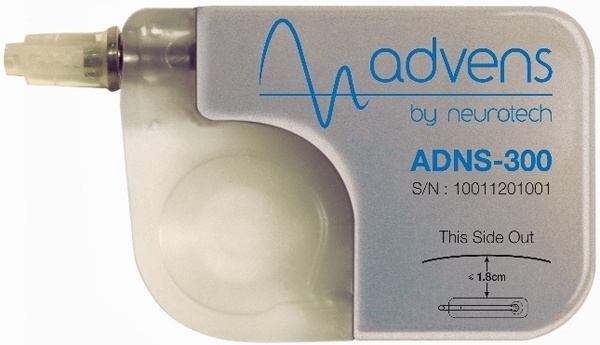
Neurotech’s ADNS-300 Rechargeable Vagus Nerve Stimulator IPG for Epilepsy

In June 2012 Neurotech s.a. (http://www.neurotech-int.eu), a Belgium based developer and manufacturer of neurostimulation devices, obtained the CE Mark for its ADNS-300 system for the treatment of refractory epilepsy. According to the press release:
“Advens therapy” uses the ADNS-300 stimulator as a therapeutic option for those patients who are refractory to anti-epileptic drugs and are not eligible for epilepsy (brain) surgery. The ADNS-300 is the world’s first rechargeable neurostimulator for vagus nerve stimulation. The device includes an innovative electrode and a promising “sensing” feature that may prove to be a significant technological breakthrough in the control of response to the therapy. Patients use a remote controller and charger to turn the system on/off and to recharge the neurostimulator. “Rechargeable systems may prove to be more cost-effective, especially if surgical operations to replace batteries are avoided over time. This helps patients to maintain a more independent life, with a lower risk of potential complications associated with battery replacement surgery.” ‘The role of Rechargeable Systems in Neuromodulation Paul Eldridge et al.’
FDA Approves St. Jude’s Ellipse™ and SJM Assura™ Portfolio of ICDs and CRT-D Devices

St. Jude Medical announced FDA approval of its next-generation Ellipse™ and SJM Assura™ portfolio of implantable cardioverter defibrillators (ICDs) and cardiac resynchronization therapy defibrillators (CRT-Ds). The new devices are designed to lower the risk of lead abrasion and to ensure high-voltage therapy delivery.
According to the announcement:
The Ellipse and SJM Assura family of devices feature the DynamicTx™ Over-Current Detection Algorithm, which automatically adjusts shocking configurations to ensure the delivery of high-voltage therapy even if an electrical short in one portion of the system were to occur. In addition, the next-generation Ellipse and SJM Assura portfolio of implantable defibrillators have a low-friction coating on the device can, which has been demonstrated in testing to significantly reduce the friction between the device and leads. As such, the low-friction coating provides an extra layer of insulation and is designed to reduce the risk for lead-to-can abrasion, the most common type of lead insulation failure in the industry.
St. Jude Medical Signs $40M Equity Investment and $300M Option with Spinal Modulation
St. Jude Medical and privately-held Spinal Modulation, Inc., today announced that they have entered into a series of agreements under which St. Jude Medical made a $40 million equity investment in Spinal Modulation, a company that has developed an innovative neuromodulation therapy that provides a new pain management option for patients with chronic, intractable pain.
According to the announcement, “the agreement provides St. Jude Medical with an exclusive option to distribute the Axium™ Neurostimulator System, developed and manufactured by Spinal Modulation, in international markets where it is approved for sale. Additionally, St. Jude Medical will have the exclusive option to acquire the company for up to $300 million plus certain revenue-based milestones following U.S. commercialization.
Sorin Receives FDA Approval for SMARTVIEW™ Remote Monitoring Solution

Sorin today announced it received FDA approval for and is beginning the U.S. launch of the SMARTVIEW™ remote monitoring solution for patients with CRM devices. From the press release:
“Using the secure SMARTVIEW remote monitoring solution, physicians and nurses following patients with a Sorin PARADYMTM RF device can access valuable cardiac data and alert messages from the device while the patient is at home. Sorin launched the PARADYMTM RF VR and DR implantable cardioverter-defibrillators (ICDs) and cardiac resynchronization therapy (CRT-D) devices in the United States in May 2012.
Biotronik Receives FDA Approval for Ilesto 7 ICD/CRT-D Series
Biotronik announced that FDA granted approval for its Ilesto 7 implantable cardioverter-defibrillator/cardiac resynchronization therapy defibrillator (ICD/CRT-D) series. According to the press release:
“BIOTRONIK lives up to its reputation for excellence in design and manufacturing with the introduction of the Ilesto family, and the new Ilesto DX device. Physicians depend on complete and timely information, and Ilesto DX with BIOTRONIK Home Monitoring® certainly delivers. With this device, physicians can receive atrial information to ensure diagnostic accuracy and identify previously undetected atrial fibrillation. They also receive peace of mind that there is less risk of complications due to the single lead,” said Paul Woodstock, executive vice president of sales and marketing at BIOTRONIK, Inc., USA. “Ilesto’s smaller footprint will be more comfortable as well, which may present a win-win solution for patients and physicians alike.”
Medtronic Announces FDA Approval of Next-Generation CRT-D and ICD IPG Families

Medtronic announced today the FDA approval of its new Viva® portfolio of cardiac resynchronization therapy with defibrillation (CRT-D) devices, and the Evera® portfolio of implantable cardioverter-defibrillators (ICD). According to the press release:
“The Viva CRT-D significantly improves response rate to the therapy for many indicated heart failure patients, with a demonstrated 21 percent reduction in overall heart failure hospitalizations within the first year after implant as compared to historical CRT trials. According to economic analyses presented at ISPOR Europe, with this device both payers and hospital providers will experience reductions in overall healthcare costs as compared to CRT-D devices with traditional programming.
NeuroVista Publishes Study Results for their Implantable Seizure-Warning Device

Seattle-based NeuroVista was founded in 2002 by Dr. Daniel DiLorenzo to develop an implantable device for the early detection of epileptic seizures. The NeuroVista seizure advisory system is based on an implantable device that senses EEG irregularities that precede a seizure. Early warning allows patients to take medicine and find a safe place to lie down. Although some epilepsy sufferers can feel seizures coming, many cannot.
In NeuroVista’s Seizure Advisory System (SAS), intracranial EEG signals are recorded through electrodes implanted between the skull and the brain surface. Data storage and signal telemetry takes place within the pectorally-implanted can that transmits signals wirelessly to an external handheld device that processes the data and transmits visual and audible signals to the patient. The external pager-like receiver displays a blue light when there is a low likelihood of seizures, white indicates medium susceptibility, and red alerts to a high likelihood of impending seizure.
Results of the system on 11 patients were published in the Lancet an a paper entitled “Prediction of seizure likelihood with a long-term, implanted seizure advisory system in patients with drug-resistant epilepsy: a first-in-man study.” From the paper:
St. Jude Launches Allure Quadra™ CRT-P IPG with Quadripolar Lead Technology
St. Jude Medical today announced CE Mark approval and European launch of its Allure Quadra™ Cardiac Resynchronization Therapy Pacemaker (CRT-P), which brings the quadripolar lead technology to the pacemaker market for the first time. According to the press release:
“Quadripolar leads allow for increased implant efficiencies, which clinical data indicates can result in fewer surgical revisions. The Allure family of devices also offer enhanced heart failure (HF) diagnostics, including CorVue™ Impedance Monitoring, for improved patient management.
Boston Scientific’s Q1 3013 AIMD Results: CRM Down 4%, Neuromodulation Up 6%

Boston Scientific Corporation announced today that it generated sales of $1.761 billion and adjusted earnings per share of $0.16 for the first quarter ended March 31, 2013. These were the results for their AIMD businesses :
- Cardiac Rhythm Management declined 5% (4% using constant-currency basis) to $478M in Q1 2013 compared to $501M in Q1 2012.
- Neuromodulation was up 6% to $89M in Q1 2013 vs. $84M in Q1 2012.
Micromagnetic Stimulation as an Alternative to Electrical Stimulation for Implantable Devices? I don’t think so…

From: Microscopic magnetic stimulation of neural tissue, Giorgio Bonmassar, Seung Woo Lee, Daniel K. Freeman, Miloslav Polasek, Shelley I. Fried & John T. Gale, Nature Communications 3, Article number: 921
The following captured my attention in the announcement of the 11th World Congress of the International Neuromodulation Society, “Technology Transforming Chronic Illness Management.” From June 8 – 13, 2013:
“Micro-Magnetic Stimulation (Monday, June 10) – John T. Gale, Ph.D., has demonstrated for the first time that deep brain stimulation with micro-magnets can activate brain cells in a living organism. Dr. Gale’s research team has shown that placing a micro-magnet on the auditory pathway of hamsters triggers nerve signal transmission. Stimulation from uniquely designed magnetic fields could avoid unintentional activation of nearby brain areas and the associated side effects. Micro-magnets might one day provide stimulation for heart pacing, cochlear implants, Parkinson’s disease, or neural prosthetics.”
I have worked on TMS before, even home-brewed a TMS device (the design of which is detailed in my book “Design and Development of Medical Electronic Instrumentation: A Practical Perspective of the Design, Construction, and Test of Medical Devices”), but it takes a very large amount of energy to induce sufficient current in the tissue to stimulate excitable tissue, so it peaked my attention that to do so at the implantable level would be under consideration.
Impulse Dynamics Launches CE-Marked OPTIMIZER IVs System for the Treatment of Heart Failure
Impulse Dynamics (yes, the company for which I work) launched its new, CE-marked OPTIMIZER™ IVs implantable device for the treatment of heart failure at the 79th Annual Meeting of the German Cardiac Society (Mannheim, Germany, 3–6 April 2013).
The OPTIMIZER™ IVs Implantable Pulse Generator (IPG) is a programmable telemetric device intended to treat moderate to severe heart failure resulting from left ventricular dysfunction by monitoring intrinsic cardiac electrical activity and delivering Cardiac Contractility Modulation (CCM) signals during the ventricular absolute refractory period. These electrical signals are intended to influence myocardial properties in patients, thereby reducing their symptoms and improving quality of life and exercise tolerance.
The OPTIMIZER™ IVs IPG was designed to deliver CCM signals during the ventricular absolute refractory period in synchrony with locally-sensed electrical activity. The microprocessor controlled implantable device comprises intracardiac electrogram sensing circuits, control logic, communications circuitry, and circuitry to generate the CCM signals. Electrogram signals are detected from and CCM signals are delivered to the heart using standard chronically-implantable bipolar pacing leads. The implant procedure is similar to implantation procedures for other cardiac rhythm management devices.