
Boston Scientific announced that it has continued to improve performance in the company’s Cardiac Rhythm Management business, achieving revenue growth of 3 percent versus the prior year period on a constant currency basis from $457M to $468M.

Boston Scientific announced that it has continued to improve performance in the company’s Cardiac Rhythm Management business, achieving revenue growth of 3 percent versus the prior year period on a constant currency basis from $457M to $468M.

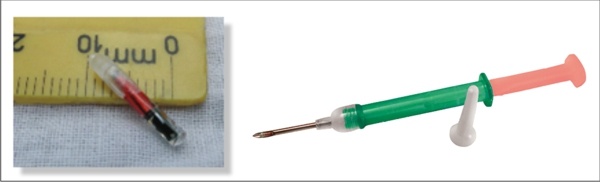
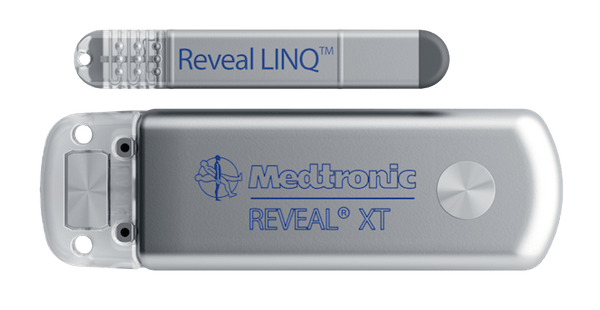
Medtronic’s new Reveal LINQ Insertable Cardiac Monitor is a tiny implantable device that weighs less than three grams and is far less invasive than any previous loop recorder. The figure above shows its diminutive size compared to the Reveal XT device – it is a full 87% smaller!
The Reveal LINQ is a leadless device that is implanted in the region of the thorax by way of a <1cm incision. Two electrodes on the body of the device continuously monitor the patient’s subcutaneous ECG. The device stores ECG recordings from the patient-activated episodes and ECG recordings from automatically detected arrhythmias.
Reveal LINQ stores a total of 57 minutes of ECG, including 27 minutes of automatically-detected episodes and up to 30 minutes of patient-activated recordings with 6.5–14 min. buffers.
The device connects wirelessly with Medtronic’s MyCareLink™ Patient Monitor, making the Reveal LINQ ICM the only ICM to collect and trend data continuously and wirelessly.
According to the press release:
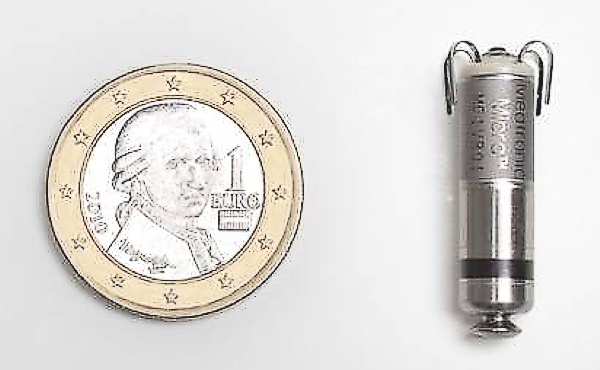
At one-tenth the size of a conventional pacemaker, and comparable in size to a large vitamin, the Micra TPS is delivered directly into the heart through a catheter inserted in the femoral vein. Once positioned, the pacemaker is securely attached to the heart wall and can be repositioned if needed. The miniature device does not require the use of wires, known as “leads,” to connect to the heart. Attached to the heart via small tines, the pacemaker delivers electrical impulses that pace the heart through an electrode at the end of the device.
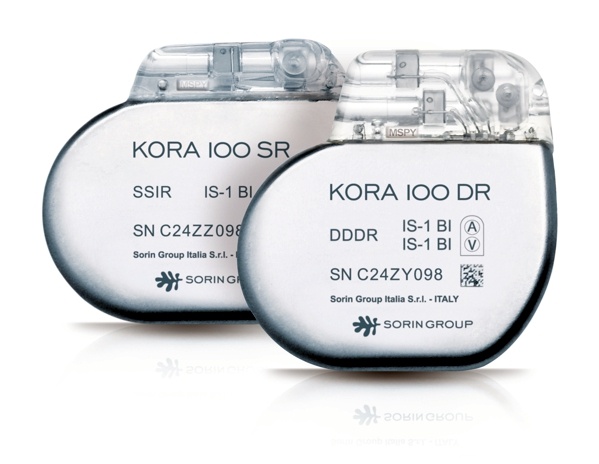
Sorin announced the CE Mark approval and first implant of its KORA 100 pacing system.
According to the press release:
KORA 100 SR and DR pacemakers when implanted with the Sorin BEFLEX pacing lead enable implanted patients to undergo magnetic resonance imaging (MRI) safely.[1] Pacemaker patients are typically older than 65 years. This patient population is prone to other medical conditions such as arthritis, cancer or stroke that may require MRI examinations for optimal diagnosis and management.
The KORA 100 pacing system has been designed with both patients and physicians in mind. Device settings which allow safe operation during an MRI examination are automatically enabled when KORA 100 pacemakers detect the scanner’s magnetic field. Similarly the devices sense when a patient leaves the MRI field, and return to normal operation within five minutes. The Automatic MRI Mode feature, which is patented and available exclusively on Sorin Group pacemakers, limits the amount of time that KORA 100 pacemakers operate in MRI mode.

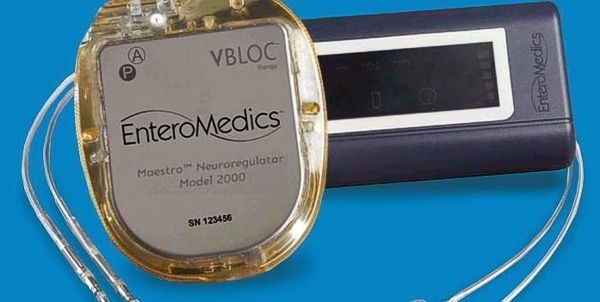
EnteroMedics reported new clinical trial data for its Maestro system, which is designed to treat obesity through vagus nerve stimulation. The company said that its Maestro RC system lost 25% of their excess weight, or 10% of their total body weight, after 18 months. Patients who received a sham implant lost 12% of excess weight, or 4% of their total weight. The company is running a five-year study of the system. The system is approved in Europe and Australia, but not the U.S.

Retrospective data for Boston Scientific’s Precision Spectra™ Spinal Cord Stimulator (SCS) System were presented at the North American Neuromodulation Society (NANS) 17th annual meeting in Las Vegas. The data show that the device provided highly significant pain relief three months after implantation.
According to the press release:
Precision Spectra is the first SCS System designed to improve pain relief using the innovative and highly advanced Illumina 3D Software, a three dimensional anatomy-driven computer model. By providing 32 contacts – twice the number of contacts available with other SCS systems – the Precision Spectra System offers more coverage of the spinal cord for the management of chronic pain.
The retrospective study of up to 213 consecutive patients at 13 centers focused on patients with chronic pain who were treated with the Precision Spectra SCS System. Results include:
A 94 percent SCS trial therapy success rate (n=213)
A highly significant reduction in pain from an average baseline score of 7.8, on a 10-point scale, to an average score of 3.2 at three months post implant (in the patients who have reached the three-month follow up, n=113)
A highly significant reduction in low back pain from an average baseline score of 7.0, on a 10-point scale, to an average of 2.9 at three months post implant (in the low back pain patients who have reached the three-month follow up, n=32)
Early results indicate improvements in function, including walking and sleeping, in addition to reductions in opioid use and disability

Medtronic today announced the first US implant of the novel Activa® PC+S deep brain stimulation (DBS) system that, for the first time, enables the sensing and recording of select brain activity while simultaneously providing targeted DBS therapy.
According to the press release:
MINNEAPOLIS – December 5, 2013 – Medtronic, Inc. (NYSE: MDT) today announced the first U.S. implants of a novel deep brain stimulation (DBS) system in research that may one day transform the treatment of devastating neurological and psychological disorders, such as Parkinson’s disease, essential tremor, dystonia, and treatment-resistant obsessive-compulsive disorder.
The Activa® PC+S DBS system delivers Medtronic DBS therapy while simultaneously sensing and recording electrical signals in key areas of the brain, using sensing technology and an adjustable stimulation algorithm. This system, which is not approved by the Food and Drug Administration for commercial use in the United States and is available to select physicians for investigational use only, may offer researchers revolutionary insights into how neurological conditions develop and progress, as well as the brain’s specific responses to Medtronic DBS therapy. Additionally, the system may provide future possibilities for creating personalized DBS therapy across a range of conditions.

St. Jude announced today that it has launched the SENSE™ Subcutaneous and Epidural Neuromodulation System Evaluation study – a clinical study to evaluate the combination of peripheral nerve field stimulation (PNfS), and spinal cord stimulation (SCS), to determine whether the two therapies together offer more effective management of chronic low back and leg pain than SCS alone.
According to the press release:
Peripheral nerve field stimulation and SCS are minimally-invasive neurostimulation therapies that involve the implant of a stimulation device and small electrical leads. In SCS, leads are placed in the epidural space to interrupt or mask the transmission of pain signals to the brain. In PNfS, leads are placed just under the skin in the subcutaneous tissue to stimulate the network of peripheral nerve fibers in order to reduce the pain at the location where it is most severe. PNfS is not the same as peripheral nerve stimulation (PNS), which targets a specific nerve. Instead, PNfS targets a more general network of nerves.
St. Jude announced today that it has initiated a clinical study of the Prodigy™ neurostimulator, which is the first SCS system able to deliver a proprietary mode of stimulation therapy called burst stimulation.
The purpose of the SUNBURST™ (Success Using Neuromodulation with BURST) study is to evaluate whether burst stimulation can be more effective in managing chronic pain than traditional tonic stimulation.
According to the press release:

Cerbomed GmbH, located in Erlangen, Germany, was founded in 2005 to develop transcutaneous Vagus Nerve Stimulation (t-VNS®) neuromodulation systems.
Surgically accessing the Vagus Nerve is not trivial, and implanting a VNS system involving cuff electrodes is risky and recovery is lengthy. Enter t-VNS, which is delivered non-invasively to the auricular branch of the vagus nerve (ABVN), making it an attractive therapy option when compared to implantable vagus nerve stimulators.
The NEMOS tVNS system consists of a handheld stimulator and a dedicated ear electrode, which patients wear like an earphone. According to Cerbomed, intensity, pulse duration and frequency of the t-VNS stimulation have been optimized to induce signals in thick-myelinated Aβ fibres of the ABVN. Like those of the cervical branch of the vagus nerve, these project directly to the nucleus of the solitary tract (NTS) in the brainstem.
In 2010 Cerbomed received the CE mark for its NEMOS® transcutaneous Vagus Nerve Stimulator for the treatment of epilepsy and depression. In 2012, the indication was expanded to include the treatment of pain.
In September 2012, Cerbomed entered into a strategic partnership with Cyberonics, Inc., the global market leader in vagus nerve stimulation. Cyberonics made an initial investment of €2 million to fund Cerbomed’s epilepsy clinical trial in Germany, with further investments of up to €5.5 million, subject to the achievement of certain clinical milestones. Cyberonics is a minority shareholder with certain rights, including representation on Cerbomed’s advisory board and an exclusive option for worldwide sales and distribution of NEMOS.
A study published on Nov 27, 2013 in the New England Journal of Medicine reports on a sudden increase in the incidence of pump thrombosis with the Thoratec HeartMate II LVAD.
The study shows an unexplained increase in thrombosis when comparing LVAD patients at three centers from January 2004 to March 2011 vs. those implanted March 2011 to April 2013. During these periods, the rate of confirmed thrombosis three months after LVAD implantation increased sharply from 2.2% to 8.4%, and median time from implantation until the development of blood clots with the devices decreased from 18.6 to 2.7 months. The increasing incidence of early thrombosis with the HeartMate II is reported to be associated with substantial morbidity and mortality.
The study was initiated by the outcome of a quality review whereby the Cleveland Clinic detected an unexpected abrupt increase in the incidence of device thrombosis. The results were reported to Thoratec and the FDA. To confirm these findings, implant data were reviewed for 895 HeartMate II devices implanted in 837 patients from 2004 to 2013 at the Cleveland Clinic, Washington Barnes-Jewish Hospital, and Duke University Medical Center. The frequency of device thrombosis increased steeply around March 2011 at the three institutions.
Dr. Randall C Starling (Cleveland Clinic, OH), the first listed author, told heartwire that the research groups are working with the Thoratec to try to identify an explanation for this issue.

EndoStim announced that Argentina’s National Administration of Drugs, Food and Medical Technology (ANMAT) approved its Lower Esophageal Sphincter (LES) Stimulation System for Gastroesophageal Reflux Disease (GERD). EndoStim is currently available in Europe, Asia and several other countries in Latin America such as Chile and Colombia.

Researchers at Harvard University and the University of Illinois at Urbana-Champaign have created and tested 3D printing inks that are electrochemically active, and with which microbatteries can be fabricated.
The ink for the anode incorporates nanoparticles of one lithium metal oxide compound, while the ink for the cathode has another type of nanoparticles. A 3D printer laid the ink onto the teeth of two gold combs to create tightly interlaced stack of anodes and cathodes. The whole setup gets packaged into a tiny container and filled with an electrolyte solution to complete the battery.
Harvard engineering professor Jennifer Lewis said: “Not only did we demonstrate for the first time that we can 3D-print a battery; we demonstrated it in the most rigorous way.” Lewis is the senior author of a study on the batteries published online in the journal Advanced Materials. The researchers say their tiny batteries have electrochemical performance is comparable to commercial batteries in terms of charge and discharge rate.
Cyberonics reported $70.1 million in sales for the quarter (fiscal Q2 2014), up around 12% from than $62.9 million booked in the fiscal 2013 second quarter. Net income grew, but at a more moderate pace. It surpassed $13.8 million, versus $13.5 million in net income booked during the same period a year ago. Operating result highlights for Q2 2014 included:
As a result, Cyberonics boosted its guidance for the rest of the 2014 fiscal year. Net sales are now expected to climb to between $281 million and $285 million, versus the $279 million to $283 million stated in previous guidance.

A position paper was published yesterday by the European Heart Rhythm Association reporting on the performance of new devices for the treatment of heart failure (HF). The report has been endorsed by the Heart Failure Association.
The abstract for the paper titled “New devices in heart failure: an European Heart Rhythm Association report” reads:
Several new devices for the treatment of heart failure (HF) patients have been introduced and are increasingly used in clinical practice or are under clinical evaluation in either observational and/or randomized clinical trials. These devices include cardiac contractility modulation, spinal cord stimulation, carotid sinus nerve stimulation, cervical vagal stimulation, intracardiac atrioventricular nodal vagal stimulation, and implantable hemodynamic monitoring devices. This task force believes that an overview on these technologies is important. Special focus is given to patients with HF New York Heart Association Classes III and IV and narrow QRS complex, who represent the largest group in HF compared with patients with wide QRS complex. An overview on potential device options in addition to optimal medical therapy will be helpful for all physicians treating HF patients.
The report places special focus to patients with HF New York Heart Association (NYHA) Classes III and IV and narrow QRS complex, who represent the largest group in HF compared with patients with wide QRS complex (who are candidates for treatment with cardiac resynchronization therapy – CRT).