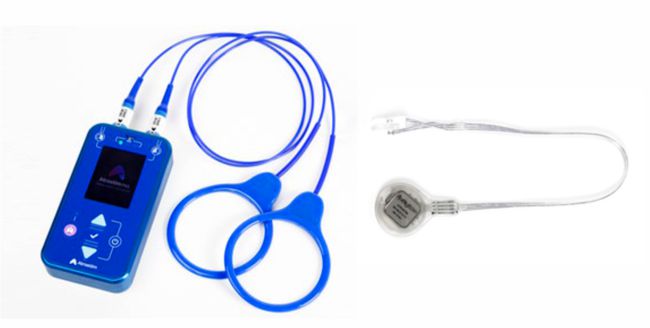
Image credit: Atrotek
My friend and colleague Nicolas Barabino, founder of Adcorpus, saw my post on the Avery phrenic nerve stimulator, and pointed me to another company in this space.
Atrotech’s RF-powered diaphragm pacing system was originally developed in Finland. Beginning in the late 1970s, Pasi P. Talonen, Gerhard A. Baer and colleagues at Tampere University of Technology developed an externally powered phrenic nerve stimulator for patients with respiratory paralysis. Their work led to the establishment of Atrotech Oy in Tampere in 1984 as a university spin-off and eventually to the commercial Atrostim phrenic nerve stimulation system.
Like the Avery diaphragm pacemaker, Atrostim uses an external transmitter and antennas to send both energy and stimulation information across intact skin to passive receivers implanted subcutaneously in the chest. Each receiver is connected to an electrode placed around a phrenic nerve, allowing bilateral stimulation to contract the diaphragm and produce inspiration. A distinctive feature of the Atrostim system is its quadripolar electrode. Four contacts surround each phrenic nerve and are activated in different combinations sequentially. This approach was developed to distribute stimulation among different portions of the nerve and reduce diaphragm fatigue during long-term pacing.
Atrostim entered clinical use around 1990, and a 1996 international study reported experience with 64 patients in 14 countries. The system subsequently became commercially available in Europe for patients with high spinal cord injuries and central hypoventilation. Atrotech remains in operation in Tampere today, now as the Finnish subsidiary of the French company Tidalium, and continues to manufacture Atrostim implants more than four decades after development of the original Tampere phrenic nerve stimulator.