The November issue of Evaluation Engineering carried an article by Tom Lecklider on the amount of work invested by Medtronic to develop and test the Revo MRI pacemaker system. The article is available on-line at Evaluation Engineering (Click here for direct link to the November 2011 issue).
Category Archives: AIMD Companies
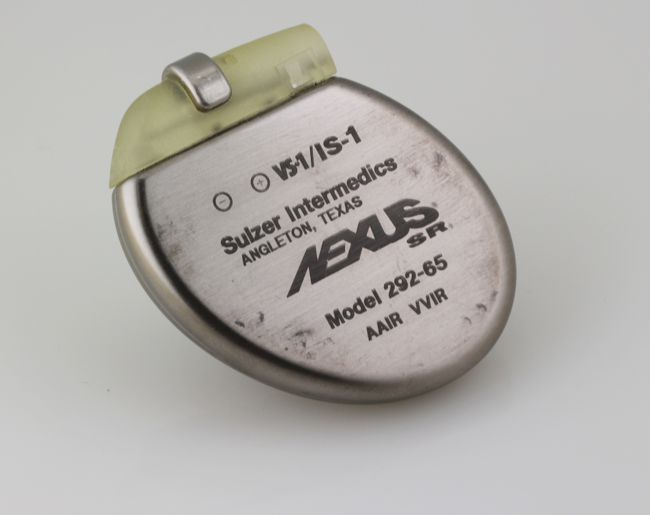
NEXUS Pacemaker with Hemodynamics Sensing and Patient Alert

(c) 2011 David Prutchi
Intermedics’ next-generation pacing platform would have been full of neat features such as: hemodynamic sensing (impedance-based hemodynamic sensor), autocapture (capture verification), autothreshold (self-tuning based on automatic strength-duration curve generation), high-quality digital telemetry, large-volume memory for electrogram storage, non-volatile memory for self-recovery and patient information, advanced noise detection, etc. My favorite feature though was “Patient Alert”. That saddle-shaped electrode in the picture was used to stimulate the patient’s pectoral muscles whenever the pacemaker wanted to alert the patient of a problem (e.g. low battery, fractured lead, etc.). The project was canceled when Guidant (now Boston Scientific) purchased Intermedics in 1998.
Tantalus II System for Treating Metabolic Syndrome
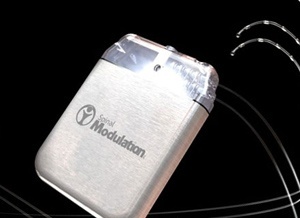
MetaCure’s TANTALUS II device is an advanced implantable electrical stimulator used to apply gastric stimulation. It works by enhancing the activity of gastric muscles only when the patient eats, which modifies hormone secretion, favorably affecting glucose and fat metabolism. At the same time, the stimulation causes the patient to feel satiated sooner and consume less food. The result is an improvement in blood glucose levels, which is often accompanied by weight loss, and reduction of blood pressure, waist circumference and blood lipid level. Continue reading
Impulse Dynamics’ OPTIMIZER III IPG for Treatment of Heart Failure
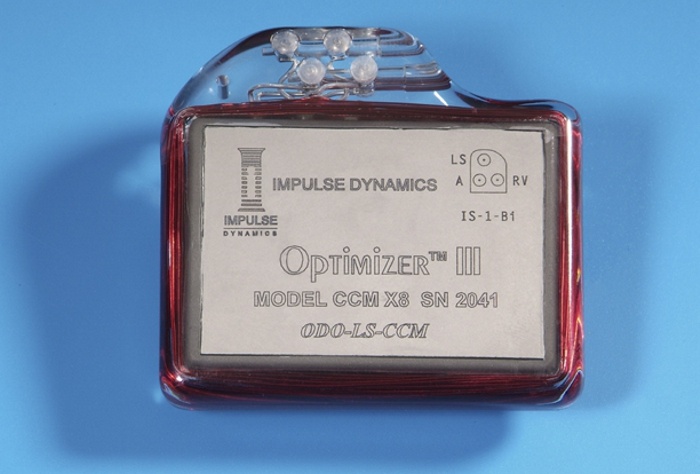
Impulse Dynamics’ OPTIMIZER™ III Implantable Pulse Generator delivers Cardiac Contractility Modulation (CCM), non-excitatory electrical signals during the myocardial absolute refractory period in synchrony with locally sensed electrical activity. CCM signals are intended to treat patients with symptomatic heart failure despite appropriate medical treatment. Continue reading