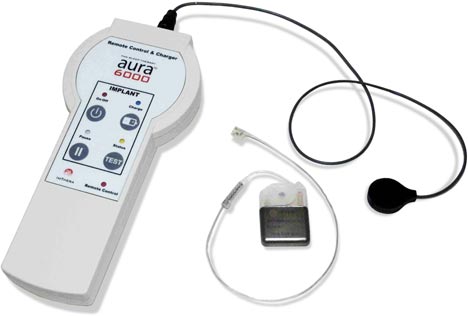
The aura6000 is based on ImThera’s Targeted Hypoglossal Neurostimulation (THN) Sleep Therapy™ delivering neurostimulation to the tongue during sleep. The system is comprised of a surgically‐placed multi‐contact electrode specifically designed for the Hypoglossal nerve, and a lead that connects the electrode to a programmable implantable pulse generator (IPG) that is placed in the anterior chest wall. The device delivers muscle tone to key tongue muscles, preventing the tongue from collapsing into the upper airway, thus permitting normal breathing during sleep. Continue reading
Category Archives: AIMD Companies
Apnex Medical’s Implantable Device for Treatment of Sleep Apnea

Image Credit: Apnex Medical
MedicalApnex Medical, Inc. is located in St. Paul, MN. It was founded in 2006 and has developed the Hypoglossal Nerve Stimulation System (HGNS® System) for the treatment of obstructive sleep apnea (OSA). The HGNS System has been evaluated in feasibility studies and is now being assessed in an Investigational Device Exemption (IDE) Study (Apnex®Clinical Study).
The Apnex HGNS System is an implantable therapy that is intended to work by activating the muscles in the upper airway to ensure that the airway remains open during sleep. During sleep, the system detects the patient’s breathing and delivers mild stimulation to the hypoglossal nerve, the nerve that controls the muscles of the tongue, to keep the airway open. The stimulation is timed to a patient’s own breathing pattern. The HGNS System is programmed to work only when the patient is asleep, or it can be turned on and off as needed through a handheld controller. Continue reading
Inspire Medical’s IPG for the Treatment of Sleep Apnea

Image credit: Inspire Medical
Inspire Medical Systems, based in Minneapolis, Minnesota, develops implantable neurostimulation systems to treat Obstructive Sleep Apnea (OSA). Inspire Medical Systems was formed when the Inspire intellectual property and technology was licensed and spun out from Medtronic in 2007.
Inspire therapy is designed to deliver physiologically-timed, mild stimulation to the hypoglossal nerve on each breathing cycle to prevent airway obstruction during sleep.
Angel Medical’s Guardian Implantable Heart Attack Monitor
Photo Credit: PRNewsFoto/Angel Medical Systems
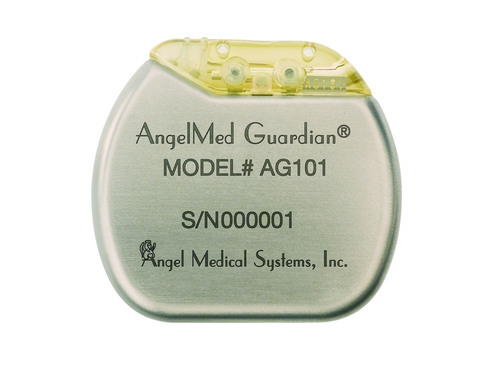
Angel Medical was founded by Dr. Robert E. Fischell and Dr. David R. Fischell. The AngelMed Guardian® system is an implantable cardiac device, designed to detect rapid ST segment shifts that may signify major cardiac events, such as coronary artery occlusions caused by life-threatening vulnerable plaque ruptures. Once an ST shift is detected, the system is designed to alert patients to seek medical care by delivering a series of vibratory, auditory, and visual warnings. The AngelMed Guardian system is intended to address the challenge of patients not recognizing nor responding quickly to heart attacks. Continue reading
Brainsgate’s Spheno-Palatine Ganglion Stimulator
Image Credit: Brainsgate Website
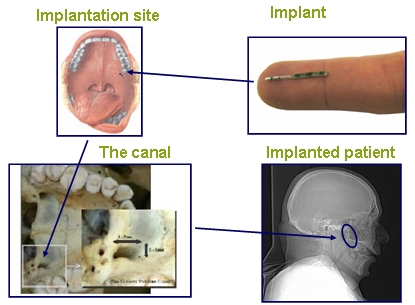
Brainsgate‘s implantable pulse generator is designed to stimulate the Spheno-Palatine Ganglion. It is activated by an external transcutaneous energy transmitter. Brainsgate is evaluating the system’s capability to augment cerebral blood flow as a treatment of ischemic stroke or dementia. Continue reading
AIMD Companies Founded by Yossi Gross
Yossi Gross (born February 5, 1947) is an Israeli medical device innovator and entrepreneur. His medical-device companies are incubated through Rainbow Medical.
Currently, the following companies led by Yossi Gross are focusing on active implantable medical devices:
- BetaStim, developing a new neurostimulation treatment for diabetes
- Brainsgate, developing an implantable device for acute stroke treatment and brain drug-delivery technology
- BioControl Medical, developing neurostimulation devices
- Enopace Biomedical, developing implantable devices for heart failure treatment through stimulation of the aorta
- CerebralRx, a spin-off from Biocontrol developing vagus nerve stimulators for the treatment of epilepsy
AIMD Companies Founded by Dr. Shlomo Ben-Haim

Dr. Shlomo Ben-Haim has held faculty appointments as a Professor of Medicine, Physiology and Biophysics, at both Harvard University and the Technion – Israel Institute of Technology. His formal education is in the fields of nuclear physics, mathematics, biomedical engineering, philosophy, and medicine. Dr. Ben-Haim has published his research in over 100 scientific papers, in peer-reviewed journals. He holds over 180 patents and patent applications.
Currently, two companies led by Dr. Ben-Haim are focusing on active implantable medical devices:
-
Impulse Dynamics, which developed the OPTIMIZER System for the treatment of heart failure
-
MetaCure, which developed the TANTALUS System for the treatment of metabolic syndrome
AIMD Companies Founded by Mir A. Imran (InCube)

Mir A. Imran (born 1956, Hyderabad, India), is an Indian entrepreneur and venture capitalist. Imran has formed 19 companies since the early 80s and holds over 140 patents. He is the founder and Chairman of InCube Laboratories, Inc., a research laboratory and business incubator for medical and technology companies
Currently, four InCube companies are focusing on active implantable medical devices:
- Intrapace, which is developing an implantable device to treat obesity
- Spinal Modulation, which is developing a novel therapy for the management of chronic pain with an implantable microstimulator
- Neurolink, which is developing a novel therapy for epilepsy
- Corhythm, which is focused on the treatment of AFIB
Spinal Modulation Neuromodulation System

Photo credits: Obtained from Spinal Modulation's site
Spinal Modulation is a company based in Menlo Park, CA. It has developed a neurostimulator for chronic intractable pain management.
According to the company, the Spinal Modulation System utilizes low-level electrical signals to modulate neural structures of primary sensory neurons located within the dorsal root ganglion (DRG). These cell bodies have been implicated in the development and maintenance of chronic pain conditions. Continue reading
MTC’s Piezos Used for Wireless Power Transmission in EBR’s Wireless Pacemaker
Morgan Technical Ceramics (MTC) announced that its Bedford, Ohio site manufactures the piezoelectric ceramic materials used in EBR Systems, Inc.’s innovative new WiCS® Wireless Cardiac Stimulation System. The PZT (lead zirconate titanate) material made by MTC is critical to the efficiency of the WiCS system, which is powered by a battery with a 10-year lifespan.
The WiCS technology, which recently began clinical trials, is the first truly wireless pacing device. It was developed to eliminate cardiac pacing leads, historically a major source of complications and reliability issues. Continue reading
Development and Test of MRI-Safe Implantable Devices
The November issue of Evaluation Engineering carried an article by Tom Lecklider on the amount of work invested by Medtronic to develop and test the Revo MRI pacemaker system. The article is available on-line at Evaluation Engineering (Click here for direct link to the November 2011 issue).
NEXUS Pacemaker with Hemodynamics Sensing and Patient Alert

(c) 2011 David Prutchi
Intermedics’ next-generation pacing platform would have been full of neat features such as: hemodynamic sensing (impedance-based hemodynamic sensor), autocapture (capture verification), autothreshold (self-tuning based on automatic strength-duration curve generation), high-quality digital telemetry, large-volume memory for electrogram storage, non-volatile memory for self-recovery and patient information, advanced noise detection, etc. My favorite feature though was “Patient Alert”. That saddle-shaped electrode in the picture was used to stimulate the patient’s pectoral muscles whenever the pacemaker wanted to alert the patient of a problem (e.g. low battery, fractured lead, etc.). The project was canceled when Guidant (now Boston Scientific) purchased Intermedics in 1998.
Tantalus II System for Treating Metabolic Syndrome
MetaCure’s TANTALUS II device is an advanced implantable electrical stimulator used to apply gastric stimulation. It works by enhancing the activity of gastric muscles only when the patient eats, which modifies hormone secretion, favorably affecting glucose and fat metabolism. At the same time, the stimulation causes the patient to feel satiated sooner and consume less food. The result is an improvement in blood glucose levels, which is often accompanied by weight loss, and reduction of blood pressure, waist circumference and blood lipid level. Continue reading
Impulse Dynamics’ OPTIMIZER III IPG for Treatment of Heart Failure
Impulse Dynamics’ OPTIMIZER™ III Implantable Pulse Generator delivers Cardiac Contractility Modulation (CCM), non-excitatory electrical signals during the myocardial absolute refractory period in synchrony with locally sensed electrical activity. CCM signals are intended to treat patients with symptomatic heart failure despite appropriate medical treatment. Continue reading