 Boston Scientific announced that it has launched a clinical trial to determine whether occipital nerve stimulation (ONS) using the Precision™ System can safely and effectively treat chronic migraine when used in conjunction with anti-migraine medications. According to the press release:
Category Archives: Neural Stimulation
AIMDs for the stimulation of the nervous system
Algostim – Greatbatch’s Own Spinal Cord Stimulation System
 Greatbatch Medical, which moved its headquarters to the Dallas, TX area last year, announced that it has set a target of at least 5%/yr organic growth. To accomplish this growth, the Company recently announced consolidating operations of its various divisions in order to create efficiency.
In addition however, Greatbatch is diversifying from being strictly a developer of implantable-grade components into a firm capable of developing complete medical devices. Greatbatch’s CEO Thomas Hook announced in March 2013 that Greatbatch is internally developing its own spinal cord stimulation system. The device, called Algostim, is nearing completion of development and will be moving into the commercialization phase. The company is looking for a partner to take the Algostim device into the $1.4 billion spinal cord stimulation market, which has been growing at more than 10%/yr.
Click here for an extract describing Algostim from Greatbatch’s investor day of March 2013.
Enopace Receives Additional $5M Investment for Development of Stimulator for Treatment of Heart Failure
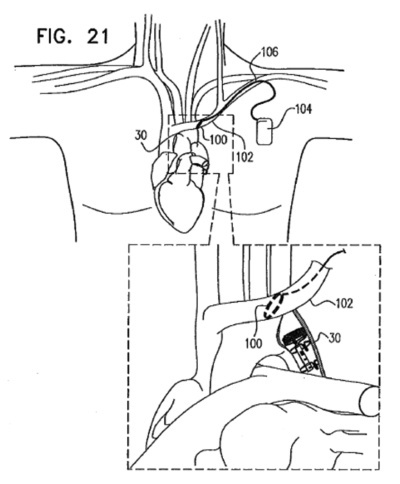
From Patent Application Publication: US 2011/0137370 A1
Sorin recently announced a $5 million investment in Israeli startup Enopace Biomedical, which is developing an endovascular neurostimulation system for heart failure. Back in October 2011 Sorin invested $7 million to finance the initial clinical studies of Enopace’s technology as well as ongoing product development.
Very scant details are available besides that it is developing a neuromodulation system to treat patients with congestive heart failure. According to the company, its technology consists of a minimally invasive, implantable neurostimulation device that increases cardiac efficiency by reducing left ventricular workload.
From Enopace’s patent applications, it seems that Enopace’s device consists of a stimulation unit that is placed within the aorta close to the heart, and which is driven wirelessly from a coil that is placed within a vein closeby to the artery. The transmitting coil is in turn driven from an implanted control unit that is implanted subcutaneously.
Israeli business news website “Globes” interviewed Enopace’s CEO Amir Dagan, and reported in February 2013:
Neuromodulation Startup NeuroTronik Raises $13.1M for Development of System for Treating Acute Heart Failure Syndrome
 NeuroTronik, a recent spin-off from Synecor, a Chapel Hill business accelerator, announced that it has raised $13.1M for the development of a neuromodulation system intended for the treatment of acute heart failure syndrome.
Douglas Reed, a partner in the VC group backing NeuroTronik said that the device aims to shorten hospital stays and reduce the need of patients to return to the hospital a few weeks later. According to Reed:
“It’s a way of stimulating the heart to increase the pumping effectiveness, the effectiveness of the contractions, so it improves cardiac function while the device is in place.”
NeuroPace Raises $18M of Planned $50M

Image Credit: NeuroPace
NeuroPace is a privately-held company in Mountain View, CA. Their RNS® implantable stimulator, along with depth leads and cortical strip leads are designed for the treatment of medically refractory partial epilepsy.
Unlike Cyberonics’ VNS IPGs, the RNS neurostimulator is designed to detect abnormal electrical activity in the brain and respond by delivering electrical stimulation to normalize brain activity before the patient experiences seizure symptoms. The neurostimulator is implanted in the cranium and connected to one or two leads that are implanted near the patient’s seizure focus.
NeuroPace recently disclosed that it has raised about $18 million of a planned $50 million in new funding. NeuroPace has raised about $180 million since it was founded in 1997.
Aleva Neurotherapeutic’s Ultra-Flexible Electrode Arrays for DBS
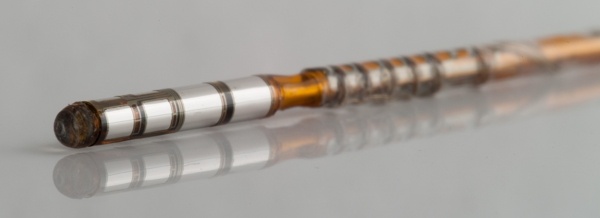
Miniature, ultra-flexible electrode (credit: EPFL)
Aleva Neurotherapeutics is a spinoff of the Swiss Federal Institute of Technology (EPFL) Microsystems Laboratory. Aleva is developing unique microfabricated devices to more specifically target deep-brain stimulation.
kurtzweilai.net recently published an interesting blog about the technology. From the post:
“Miniature, ultra-flexible electrodes could be the answer to more successful treatment for Parkinson’s diseases, according to Professor Philippe Renaud of the École Polytechnique Fédérale de Lausanne (EPFL) in Switzerland.
He has developed soft arrays of miniature electrodes in his Microsystems Laboratory that open new possibilities for more accurate and local deep brain stimulation (DBS).
Mainstay Medical’s Reactiv8 to Treat LBP Caused by Arthrogenic Muscle Inhibition
![logo_mainstay1[1]](https://www.implantable-device.com/wp-content/uploads/2013/06/logo_mainstay11.jpg)
Mainstay Medical was founded in 2008 by entrepreneur Dr. Danny Sachs. The company’s ReActiv8 neurostimulator is intended to treat chronic low back pain caused by arthrogenic muscle inhibition. This is a neuroprotective condition in which the brain reflexively attempts to limit motor stimulation and movement in muscles surrounding a joint in response to damage or injury to the joint. In patients with this type of back pain, an initial injury triggers this reflexive inhibition, and the brain tries to limit painful movement by altering nerve transmissions to the deep stabilizing muscles of the spine, causing a loss of motor control, an unstable spine, and greater susceptibility to reinjury.
Neuros Medical’s Altius™ High Frequency Electrical Nerve Block™ Pain Therapy
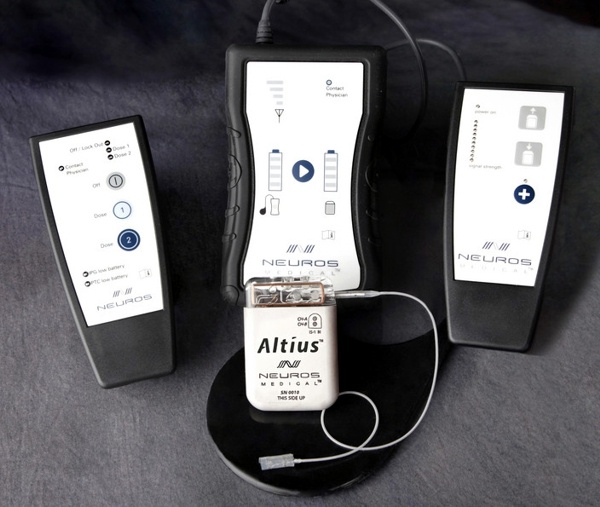
Neuros Medical, a Cleveland, Ohio based neuromodulation company, developed the Altius implantable system to deliver Electrical Nerve Block therapy for the treatment of chronic pain in a variety of applications including neuroma/residual limb pain, chronic post surgical pain, and chronic migraine.
Boston Scientific Begins Patient Enrollment in U.S. Clinical Trial of Vercise™ DBS for Parkinson’s Disease, Presents EU Data
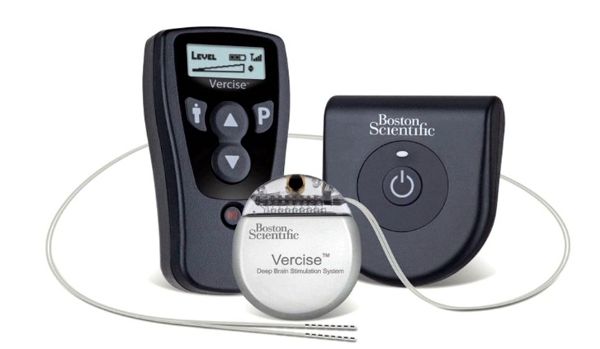
Image Credit: Boston Scientific
Boston Scientific announced today the first implantation of its Vercise™ DBS System as part of the INTREPID clinical trial. INTREPID is a prospective, multi-center, double-blinded, randomized, controlled study to evaluate the safety and effectiveness of motor function and overall quality of life in patients with the Vercise DBS System for the treatment of Parkinson’s disease. According to the press release:
Neurotech’s ADNS-300 Rechargeable Vagus Nerve Stimulator IPG for Epilepsy
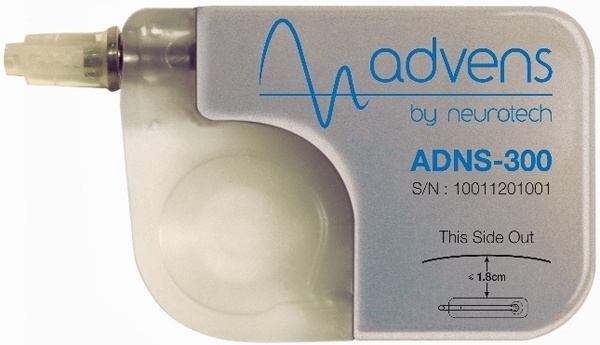
In June 2012 Neurotech s.a. (http://www.neurotech-int.eu), a Belgium based developer and manufacturer of neurostimulation devices, obtained the CE Mark for its ADNS-300 system for the treatment of refractory epilepsy. According to the press release:
“Advens therapy” uses the ADNS-300 stimulator as a therapeutic option for those patients who are refractory to anti-epileptic drugs and are not eligible for epilepsy (brain) surgery. The ADNS-300 is the world’s first rechargeable neurostimulator for vagus nerve stimulation. The device includes an innovative electrode and a promising “sensing” feature that may prove to be a significant technological breakthrough in the control of response to the therapy. Patients use a remote controller and charger to turn the system on/off and to recharge the neurostimulator. “Rechargeable systems may prove to be more cost-effective, especially if surgical operations to replace batteries are avoided over time. This helps patients to maintain a more independent life, with a lower risk of potential complications associated with battery replacement surgery.” ‘The role of Rechargeable Systems in Neuromodulation Paul Eldridge et al.’
St. Jude Medical Signs $40M Equity Investment and $300M Option with Spinal Modulation
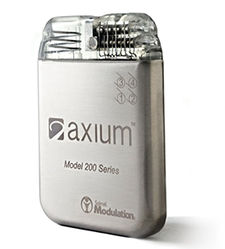 St. Jude Medical and privately-held Spinal Modulation, Inc., today announced that they have entered into a series of agreements under which St. Jude Medical made a $40 million equity investment in Spinal Modulation, a company that has developed an innovative neuromodulation therapy that provides a new pain management option for patients with chronic, intractable pain.
According to the announcement, “the agreement provides St. Jude Medical with an exclusive option to distribute the Axium™ Neurostimulator System, developed and manufactured by Spinal Modulation, in international markets where it is approved for sale. Additionally, St. Jude Medical will have the exclusive option to acquire the company for up to $300 million plus certain revenue-based milestones following U.S. commercialization.
Micromagnetic Stimulation as an Alternative to Electrical Stimulation for Implantable Devices? I don’t think so…

From: Microscopic magnetic stimulation of neural tissue, Giorgio Bonmassar, Seung Woo Lee, Daniel K. Freeman, Miloslav Polasek, Shelley I. Fried & John T. Gale, Nature Communications 3, Article number: 921
The following captured my attention in the announcement of the 11th World Congress of the International Neuromodulation Society, “Technology Transforming Chronic Illness Management.” From June 8 – 13, 2013:
“Micro-Magnetic Stimulation (Monday, June 10) – John T. Gale, Ph.D., has demonstrated for the first time that deep brain stimulation with micro-magnets can activate brain cells in a living organism. Dr. Gale’s research team has shown that placing a micro-magnet on the auditory pathway of hamsters triggers nerve signal transmission. Stimulation from uniquely designed magnetic fields could avoid unintentional activation of nearby brain areas and the associated side effects. Micro-magnets might one day provide stimulation for heart pacing, cochlear implants, Parkinson’s disease, or neural prosthetics.”
I have worked on TMS before, even home-brewed a TMS device (the design of which is detailed in my book “Design and Development of Medical Electronic Instrumentation: A Practical Perspective of the Design, Construction, and Test of Medical Devices”), but it takes a very large amount of energy to induce sufficient current in the tissue to stimulate excitable tissue, so it peaked my attention that to do so at the implantable level would be under consideration.
Boston Scientific Acquires and Launches Fixate Tissue Band for Spinal Cord Stimulator Leads and Pain Pump Catheters
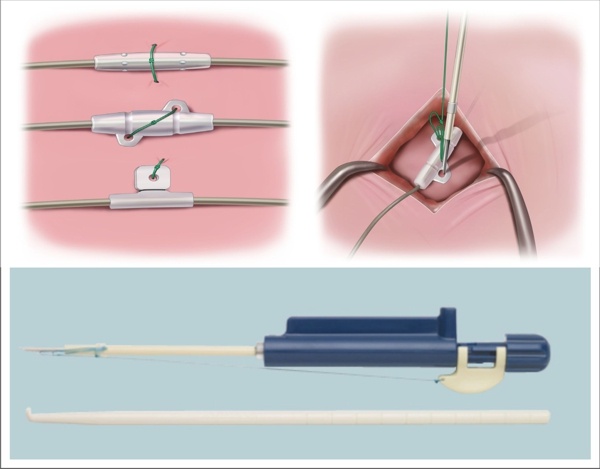
Boston Scientific announced today that it has acquired the fiXate™ Tissue Band and is launching it in the United States. The fiXate Tissue Band is intended to be an accessory to the leads/catheter component of Spinal Cord Stimulator/Pain Pump systems functioning to secure the lead to the fascia or inter-spinous/supra-spinous ligament. According to the press release:
“The fiXate Tissue Band is a novel suturing device that is designed to enable quick and simple placement of a suture to help secure a spinal cord stimulator (SCS) lead or pain pump catheter. Boston Scientific introduced the device earlier this month at the annual meeting of the American Academy of Pain Medicine in Fort Lauderdale. The product was purchased from Anulex Technologies, Inc.
Boston Scientific’s Precision Spectra™ 32-Contact SCS Launched in the US
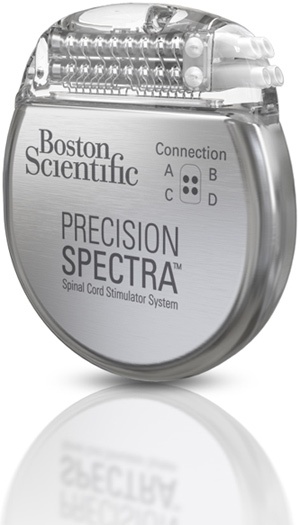 Boston Scientific received FDA approval and is beginning a limited launch of the Precision Spectra Spinal Cord Stimulator (SCS) System. According to the press release:
“The Precision Spectra System is the world’s first and only SCS system with Illumina 3D™ software and 32 contacts, and is designed to provide improved pain relief to a wide range of patients who suffer from chronic pain. Boston Scientific, the United States market leader in rechargeable SCS devices exiting 2012, is introducing the system at the annual meeting of the American Academy of Pain Medicine in Fort Lauderdale, Florida. Images of the Precision Spectra System can be downloaded here.
More than 100 million Americans suffer from chronic pain. Living in constant pain for an extended period of time can have a devastating impact on quality of life for many patients. Without relief, or the hope for relief, many patients lose the ability to sleep, work and function normally.
Medtronic’s Fully Implantable Percutaneous Nerve Stimulation (PNS) System for Treatment of Lower Back Pain
 In May 2011 Medtronic received the CE Mark for the first 16-electrode, fully implantable system for the percutaneous delivery of peripheral nerve stimulation (PNS) in the management of chronic back pain.
PNS involves an implant of electrical leads just under the skin of the lower back. These leads are connected to a stimulator which delivers mild electrical impulses to the nerves, interrupting pain signals traveling through the nervous system to the brain.
Medtronic today announced the first patient enrollments in the SubQStim II pivotal clinical trial to pursue FDA approval PNS (also known as subcutaneous nerve stimulation or SQS), for the reduction of chronic, intractable post-surgical back pain.