Image Credit: St. Jude Medical

Image Credit: St. Jude Medical

Today Boston Scientific Corporation announced financial results for the fourth quarter and full year ended December 31, 2011. Summarizing the AIMD data:
Click here for the news release.

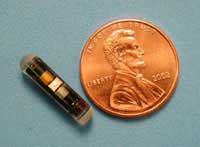
Remon Medical Technologies, Ltd. was founded in 1997 in Caesarea, Israel to develop implantable, wireless pressure sensors.
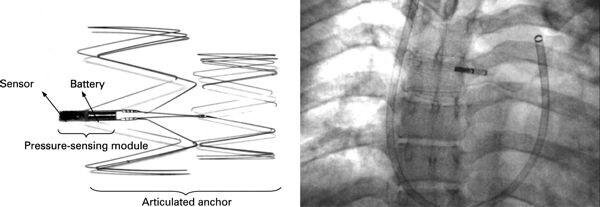
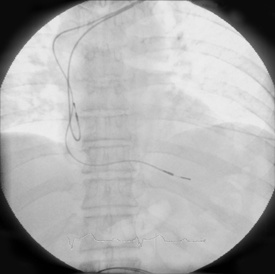
Remon developed an implantable hemodynamic monitor, which allowed on-demand, non-invasive, leadless self-monitoring of pulmonary artery pressure by the patient at home. ImPressure devices were placed in the pulmonary artery, and transmitted pressure readings to a hand-held monitor. It was hoped that the system would provide early warning of the need for treatment, avoiding hospitalization and deterioration in the patient’s condition. Continue reading→
Sensors for Medicine and Science, Inc. (SMSI) of Germantown, MD was founded in 1997 to develop chemical sensing technologies based on fluorescence sensing.
SMSI® is now developing an implantable glucose sensor that is designed to automatically measure interstitial glucose every few minutes. The sensor implant communicates wirelessly with a small external reader, allowing it to track the rate of change of glucose levels and warn the user of impending hypo- or hyperglycemia. According to SMSI, the target operational life of the sensor implant will be 6-12 months, after which it would be replaced. Continue reading→

St. Jude Medical today reported sales and net earnings for the fourth quarter and year ended December 31, 2011. From the press release:
“Cardiac Rhythm Management
Total CRM sales, which include implantable cardioverter defibrillator (ICD) and pacemaker products, were$728 million for the fourth quarter of 2011, a 4 percent decrease compared to the fourth quarter of 2010. After adjusting for the impact of foreign currency, total CRM sales decreased 6 percent. Total CRM product sales for the full-year 2011 were $3.034 billion, essentially equal to 2010. On a currency neutral basis, total CRM sales declined 3 percent from the prior year. Continue reading→

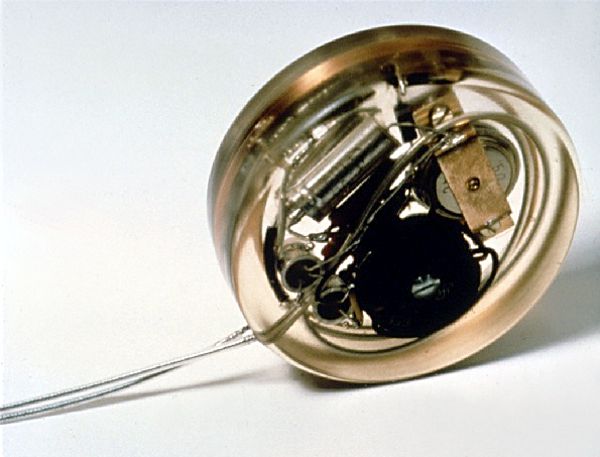
This is a picture of the first pacemaker to be implanted in a human patient. It was developed by Dr. Rune Elmqvist (1906–1996), a physician by training, but working for the Swedish company Elema-Schonander as an engineer. Dr. Elmqvist developed the device in cooperation of Åke Senning, senior physician and cardiac surgeon at the Karolinska University Hospital in Solna, Sweden. Continue reading→
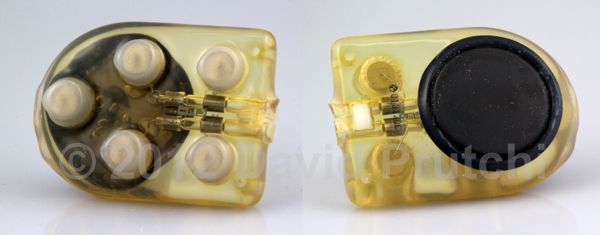
The development of medical devices, drugs, and treatments depends on accurately retrieving clinical data from implanted animals. Implantable data collecting and sensing devices provide one way to retrieve these data. These device often include sensors or electrodes which must be implanted within the subject in order to provide clinicians with access to the sensed information.
Retrieving data from implanted sensors poses a potential problem since data frequently must be retrieved on numerous different occasions and over an extended period of time. If surgery is required each time data is retrieved, the subject may be overly exposed to stress, trauma, or risk of infection. In order to develop and test cardiac pacemakers and defibrillators, for example, clinicians need to monitor electrical activity of the subject’s heart. One way to monitor this activity is to surgically implant one end of a lead to the heart. The other end of the lead may be left subcutaneously (i.e., under the skin) or transcutaneously (i.e., through the skin). In the former instance, access to the electrode may require an invasive procedure, such as surgery. In the latter instance, prolonged and chronic exposure of the electrode through the skin may cause discomfort, lead to infection, or cause damaging stress on the electrode. Continue reading→

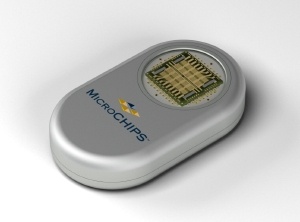
Image Credit: MicroCHIPS
MicroCHIPS was founded in 1999 as an MIT spinoff to develop implantable sensors and drug-delivery devices.
MicroCHIPS’ drug-delivery technology is based on proprietary reservoir arrays that are used to store potent drugs within the body for long periods of time. Individual device reservoirs can be opened on demand or on a predetermined schedule to precisely control drug release or sensor activation. Continue reading→

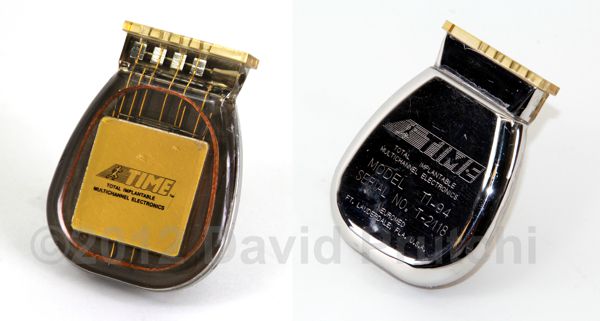
Neuromed TIME IPG on loan from Daniel Villamil's collection.
Neuromed was formed in 1980 with an initial capitalization of $150,000 by Bill Borkan through money obtained when Borkan`s parents took out a second mortgage on their home. Borkan’s desire to help his sister, Jennie, a cerebral palsy patient, got him started in neurostimulation technology. In the next few years, Neuromed developed and marketed a RF-powered implantable spinal cord stimulator, along with its external radio frequency transmitter.
Throughout the 1980s, development of more advanced devices was ongoing at Neuromed. My friend Daniel Villamil from CCC Medical has in his collection one of these more modern units, which he lent to me for photographing. The “Total Implantable Multichannel Electronics” (TIME) spinal cord stimulator shown in this picture went into clinical trials around 1988. This was a device that was internally powered by its own battery. However, it could also be RF-powered after the eventual battery failure. Continue reading→

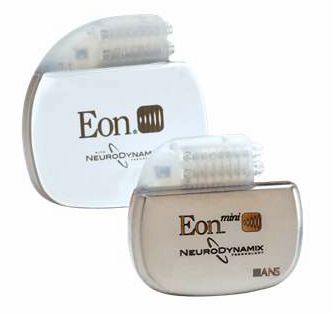
In 2005, St. Jude Medical purchased Advanced Neuromodulation Systems (ANS) in Plano, Texas. ANS had developed a number of spinal cord stimulation IPGs that were either externally powered via inductive link, internally powered by a primary cell, or internally powered by a transcutaneously rechargeable lithium-ion cell.
Today, the most popular St. Jude spinal cord stimulators are the rechargeable 42 cc Eon and 18 cc Eon mini neurostimulators.
They are constant-current devices with a rated longevity of 10 years. Current through up to 16 electrodes is programmable between 0-25.5 mA with a pulse width of 50-500 µs and a frequency between 2-1200 Hz. Continue reading→

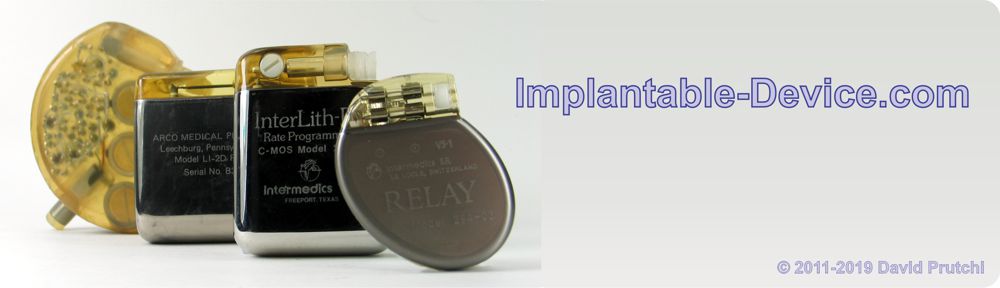
In 1973, former Medtronic sales representative Albert Beutel founded Intermedics in Freeport, TX. The first product was a small, mercury-cell-powered pacemaker. In 1974 Intermedics introduced a lithium-powered version, and in 1976 it introduced InterLith which was hermetically sealed, and weighed just 65 grams. At the time, InterLith’s size was a breakthrough, and became a very popular device, solidifying Intermedics’ position in the industry.

Some time ago, my friend and colleague Paul Spehr gave me a copy of Arco Medical’s product catalog. I scanned the original datasheets for Arco Medical’s nuclear fixed-rate and demand pacemakers models NU-5 and NU-6 and posted them here in pdf format: Arco_Nuclear_Datasheets
Click here for a color picture and more information on Arco Medical’s nuclear pacemakers.

Today St. Jude announced that its first controlled study of Deep Brain Stimulation (DBS) confirms benefit of constant current system for patients with Parkinson’s Disease.
Results were published online today by The Lancet Neurology journal. The aim of the study was to evaluate the Libra(TM) and LibraXP(TM) DBS constant current systems to determine the devices’ safety and effectiveness in managing the symptoms of PD. Continue reading→
Yesterday, Jan 9, 2011, St. Jude Medical announced preliminary revenue results for the fourth quarter ended December 31, 2011:
“Fourth quarter cardiac rhythm management sales were approximately $728 million, a 4 percent decrease compared with the fourth quarter of 2010. Fourth quarter sales of implantable cardiac defibrillators were approximately $436 million, a 5 percent decrease from the comparable quarter in 2010. Pacemaker sales during the quarter were approximately $292 million, a 4 percent decrease compared with the fourth quarter of 2010.
…
Fourth quarter sales of neuromodulation products were approximately $121 million, a 12 percent increase compared to the fourth quarter of 2010.”
Company website: www.sjm.com

The Cardio Care II Pacemaker was American Optical’s second implantable device. It was an improved version of the Cardio Care pacemaker. Besides improvements to the circuitry, the circuit board was enclosed separately inside a hermetic can within the epoxy encapsulation. Continue reading→