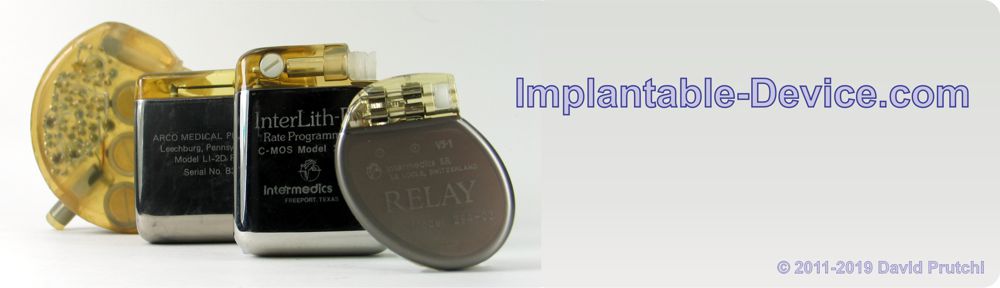
In this TED talk, Hugo Campos explains his frustration with the fact that his ICD collects data, but he – as a patient – is unable to access these data as a diagnostic tool to help make good choices about eating, exercise and other activities.
Category Archives: Tech Talk
Monash University in Australia Starts Test of Direct-to-Brain Visual Prosthesis Chips
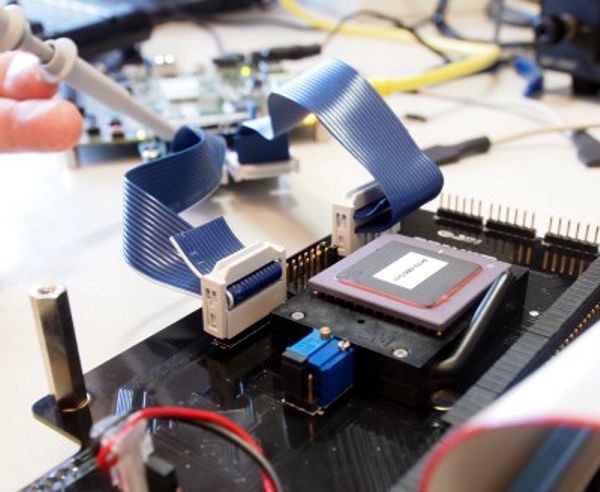
Image Credit: Monash Vision Group, Monash University, Australia
Engineers from the Monash Vision Group (MVG) have begun trialling the ASICs for a direct-to-brain visual prosthesis that is expected to enter human clinical trials in 2014.
The prosthesis will consist of a tiny camera mounted into a pair of glasses, which acts as the retina; a pocket processor, which takes the electronic information from the camera and converts it into signals enabling the brain to build up a visual construct; and cortical implants of several tiles which will be the portal for the stimulation of the visual cortex. Continue reading
Magnetically-Coupled Motor/Generator Transfers 100 mW to Implant at 50 cm Range
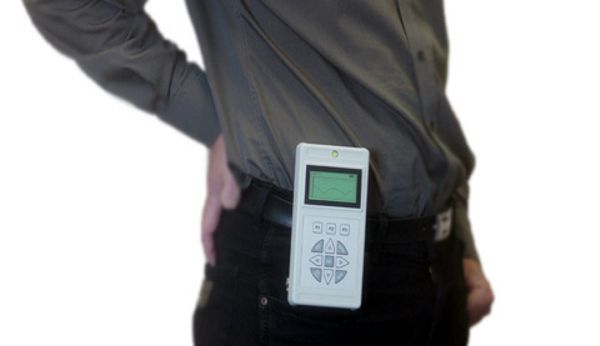
Image Credit: Fraunhofer Institute for Ceramic Technologies and Systems
Scientists at the Fraunhofer Institute for Ceramic Technologies and Systems developed a magnetically-coupled motor/generator system that they claim is able to transcutaneously transfer 100 mW to an implant up to 50 cm away.
In the external power-transfer module, a rotating magnet driven by an EC motor generates a magnetic rotary field. A magnetic pellet in the implanted receiver connects to the alternating exterior magnetic field and as a result, is set in rotation itself. The rotational movement is transformed into electricity, thus the power is produced right in the generator module. “With magnetic coupling, power can be transported through all non-magnetic materials, such as biological tissue, bones, organs, water, plastic or even a variety of metals. Moreover, the magnetic field produced has no harmful side effects on humans. It doesn‘t even heat up tissue,” says Dr. Holger Lausch, highlighting the advantages of the system. Continue reading
John Hopkins Researcher Develops New Early-Warning Seizures Detector with Low False-Positive Rate
 Johns Hopkins’ Sridevi V. Sarma, an assistant professor of biomedical engineering, has devised new seizure detection software that, in early testing, significantly cuts the number of unneeded brain-stimulation therapy that an epilepsy patient would receive.
According to Sarma, “These devices use algorithms—a series of mathematical steps—to figure out when to administer the treatment,” Sarma said. “They’re very good at detecting when a seizure is about to happen, but they also produce lots of false positives, sometimes hundreds in one day. If you introduce electric current to the brain too often, we don’t know what the health impacts might be. Also, too many false alarms can shorten the life of the battery that powers the device, which must be replaced surgically.” Continue reading
FDA AIMD PMA/Supplement Approvals for January
 FDA released its PMA/Supplement approvals for January. The edited version below has been edited to include only AIMDs. It is not the full list, and should be used only for general information purposes.
Cool Reed Switch Manufacturing Video

Magnetic reed switches are used in active implantable medical devices as a simple way of placing the device in a known operational mode when a programmer is not available. For example, placing a magnet on a pacemaker sets it to VVI mode with a manufacturer-specified set of parameters. In other devices (e.g. implantable cardioverter/defibrillators), placing a magnet on the IPG inhibits the delivery of high voltage defibrillation.
Although the reed switches that I use don’t come from Meder Electronics, I came across a very cool video that Meder produced regarding their manufacturing process. Continue reading
News from Stanford: Modelling Tissue as a Dielectric Shows Feasibility of Inductive Power Transfer at 1 GHz
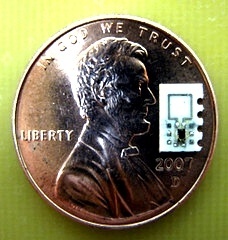
Image Credit: Stanford University
Stanford Engineering assistant professor Ada Poon demonstrated a tiny, wirelessly powered, self-propelled medical device capable of controlled motion through blood. The device drives electrical current directly through the fluid, which in the presence of an external magnetic field creates a directional force that pushes the device forward. This type of device is capable of moving at just over half-a-centimeter per second.
That was the news picked up by bloggers from Poon’s presentation at the International Solid-State Circuits Conference (ISSCC). However, what caught my attention is her work on inductive transcutaneous energy transmission. From Stanford’s press release: Continue reading
Purdue University’s Concept for Music-Powered Implantable Devices
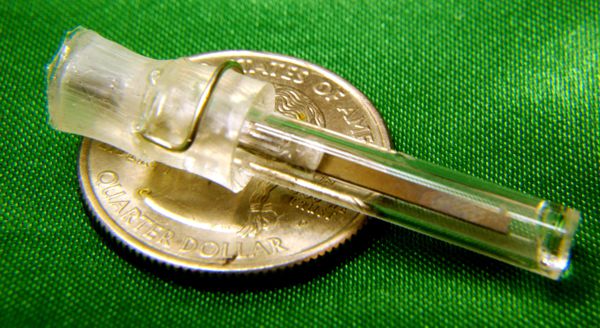
Image Credit: Purdue University
A group of researchers at Purdue University led by Prof. Babak Ziaie developed a vibrating cantilever that is excited by an external bass source from 200-500 Hz. The excitation causes the cantilever to vibrate, generating electricity and storing a charge in a capacitor.
Although playing tones within a certain frequency range would be ideal, the group concentrated on the use of music as an excitation source. According to the researchers, “a plain tone is a very annoying sound. We thought it would be novel and also more aesthetically pleasing to use music.” Continue reading
Crazy Pacemaker Hack: d.i.y. High-Speed Photography

This is a hack that combines three of my favorite passions: pacemakers, photography, and coffee!
I took this photograph by feeding the output of an infrared barrier to the atrium input of an old DDD pacemaker, setting an appropriate AV delay, and using the ventricular output to trigger a camera flash (via a optoisolator). In a darkened room, I opened my camera’s shutter for 2 seconds. I then let one drop of milk fall through the infrared barrier, starting the AV delay in VAT mode. The flash then fires as the drop enters the coffee in the cup, freezing the action. Continue reading
St. Jude’s (ANS) Rechargeable Spinal Cord Stimulators Eon and Eon Mini
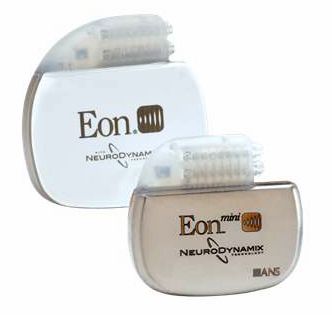
In 2005, St. Jude Medical purchased Advanced Neuromodulation Systems (ANS) in Plano, Texas. ANS had developed a number of spinal cord stimulation IPGs that were either externally powered via inductive link, internally powered by a primary cell, or internally powered by a transcutaneously rechargeable lithium-ion cell.
Today, the most popular St. Jude spinal cord stimulators are the rechargeable 42 cc Eon and 18 cc Eon mini neurostimulators.
They are constant-current devices with a rated longevity of 10 years. Current through up to 16 electrodes is programmable between 0-25.5 mA with a pulse width of 50-500 µs and a frequency between 2-1200 Hz. Continue reading
Biotectix

- Image Credit: Biotectix
Biotectix of Ann Arbor, MI recently contacted me to let me know of new conductive polymer materials that they are developing to enhance the performance of next-gen implantable stimulation and sensing devices.
Indeed, their materials sound very promising. According to Biotectix, their electrode coatings and device components are made from proprietary conducting polymers that provide intimate, long-term electrical and biological connections between implantable electrodes and the target tissue. They offer the conductivity and stability of metals at a low-cost with the ease of processing and biological functionality of polymers. Continue reading
Reliability Analysis of Active Implantable Medical Devices
 We conduct reliability analyses for our implantable devices on a continued basis. I’ve spent the last few days readying the data for this period’s analysis, and thought that a short primer on how this is actually done would be of interest to fellow engineers who may need it at some point.
You surely have heard of MTBF = Mean Time Between Failures. This is a key reliability metric. However, since our implantable devices are single-use, the first failure is the final failure, so MTTF = Mean Time To Failure. As such, for a device with no possibility of repair (e.g. implantables, satellites), MTBF=MTTF. Continue reading