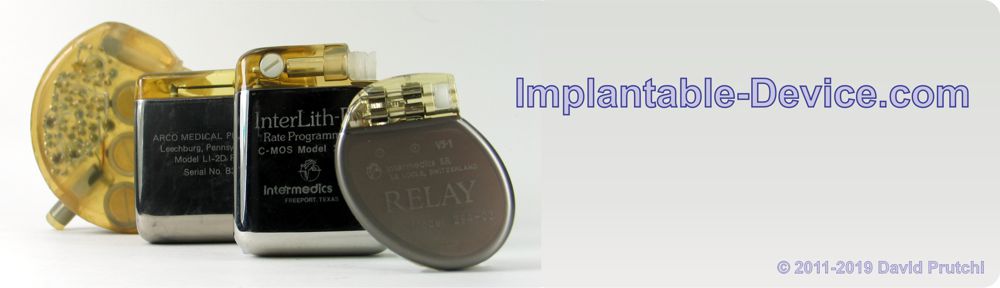
This was achieved in Uruguay on February 2, 1960 by Dr. Orestes Fiandra and Dr. Roberto Rubio. The pacemaker was manufactured by Dr. Rune Elmqvist of Elema-Schönander in Sweden, and was implanted in Uruguay in a 34-year-old patient with AV block. This unit worked successfully for nine and a half months, until the patient died of sepsis from an unrelated infection. Continue reading
Category Archives: Bradycardia
Implantable devices for the treatment of bradycardia (pacemakers)
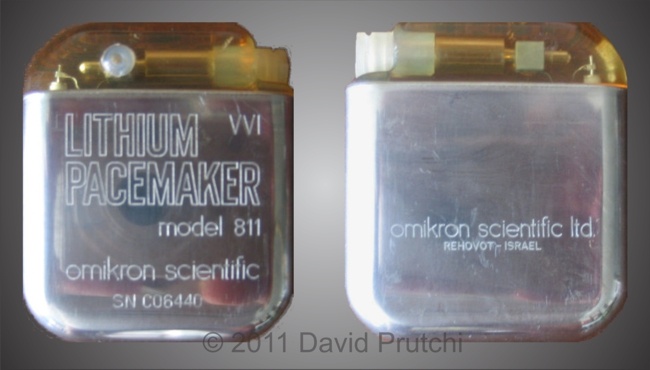
Omikron Scientific – Israeli Pacemaker Company (1979-1985)
Omikron Scientific was a small-scale pacemaker company founded in Rehovot, Israel in 1979. The company stopped pacemaker production in 1985.
Besides pacemakers, Omikron also produced a skin substitute called Omniderm, which was a thin, transparent, flexible membrane. It was used when a biological dressing would otherwise have been used.
Omikron’s pacemakers were all VVI and featured gradual decline Magnet Rate & Programmed Rate. Models included the 811 (6.5 year longevity), 811L (10 year longevity), 811XL (14 year longevity), 821 (VVIM with 8 year longevity), 837, a 838 (6.5 year longevity).
Click here for Omikron’s patents.
AIMD Companies Founded by Dr. Robert Fischell
Dr. Fischell received his BSME degree from Duke University and MS and Sc.D. degrees from the University of Maryland. Dr. Fischell was employed at the Johns Hopkins University where he was the Chief Engineer of the Space Department and worked on more than 50 spacecraft. His interests at Johns Hopkins then turned to the invention of new medical devices such as pacemakers and implantable heart defibrillators. Starting in 1969, Dr. Fischell began the formation of 14 private companies that licensed his patents on medical devices. These companies include Pacesetter Systems, Inc. (now called St. Jude Medical), IsoStent, Inc., NeuroPace, Inc., Neuralieve, Inc., Angel Medical Systems, Inc, and Svelte Medical Systems, Inc. Dr. Fischell is a prolific inventor with over 200 issued U.S. and foreign patents, many of which have been the basis for new medical device companies. Continue reading
MTC’s Piezos Used for Wireless Power Transmission in EBR’s Wireless Pacemaker
Morgan Technical Ceramics (MTC) announced that its Bedford, Ohio site manufactures the piezoelectric ceramic materials used in EBR Systems, Inc.’s innovative new WiCS® Wireless Cardiac Stimulation System. The PZT (lead zirconate titanate) material made by MTC is critical to the efficiency of the WiCS system, which is powered by a battery with a 10-year lifespan.
The WiCS technology, which recently began clinical trials, is the first truly wireless pacing device. It was developed to eliminate cardiac pacing leads, historically a major source of complications and reliability issues. Continue reading
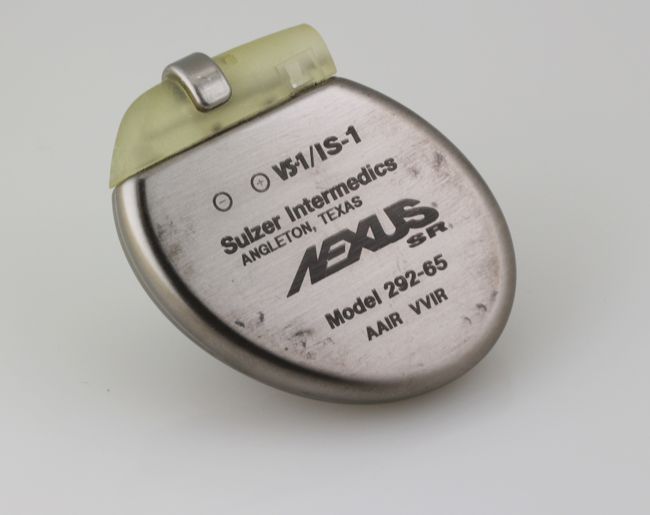
NEXUS Pacemaker with Hemodynamics Sensing and Patient Alert

(c) 2011 David Prutchi
Intermedics’ next-generation pacing platform would have been full of neat features such as: hemodynamic sensing (impedance-based hemodynamic sensor), autocapture (capture verification), autothreshold (self-tuning based on automatic strength-duration curve generation), high-quality digital telemetry, large-volume memory for electrogram storage, non-volatile memory for self-recovery and patient information, advanced noise detection, etc. My favorite feature though was “Patient Alert”. That saddle-shaped electrode in the picture was used to stimulate the patient’s pectoral muscles whenever the pacemaker wanted to alert the patient of a problem (e.g. low battery, fractured lead, etc.). The project was canceled when Guidant (now Boston Scientific) purchased Intermedics in 1998.